
The Best Accessible Things to Do in Annapolis, Maryland (2026)
Annapolis is one of the oldest cities in America, and with it also along the coast, it makes for an incredible place to visit.
But the main question is: is it accessible? And this question might surprise you, but yes it is. Even their historic downtown has smooth sidewalks and well-maintained curb cuts throughout.
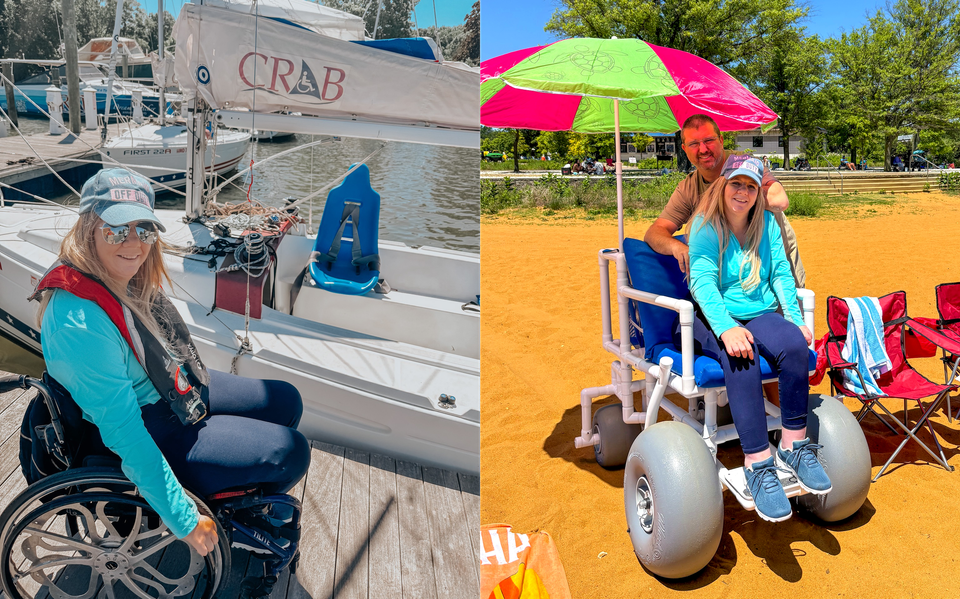
There are so many accessible things to do here, including adaptive sailing with Chesapeake Region Accessible Boating, free beach wheelchair rentals for Sandy Point State Park, and exceptional museums with deep history.
All venues below are on-site verified by Wheel the World, with the exception of Downtown Annapolis, which is based on firsthand experience from a verified traveler. Every measurement in this article was collected during an in-person visit by a Wheel the World trained mapper.
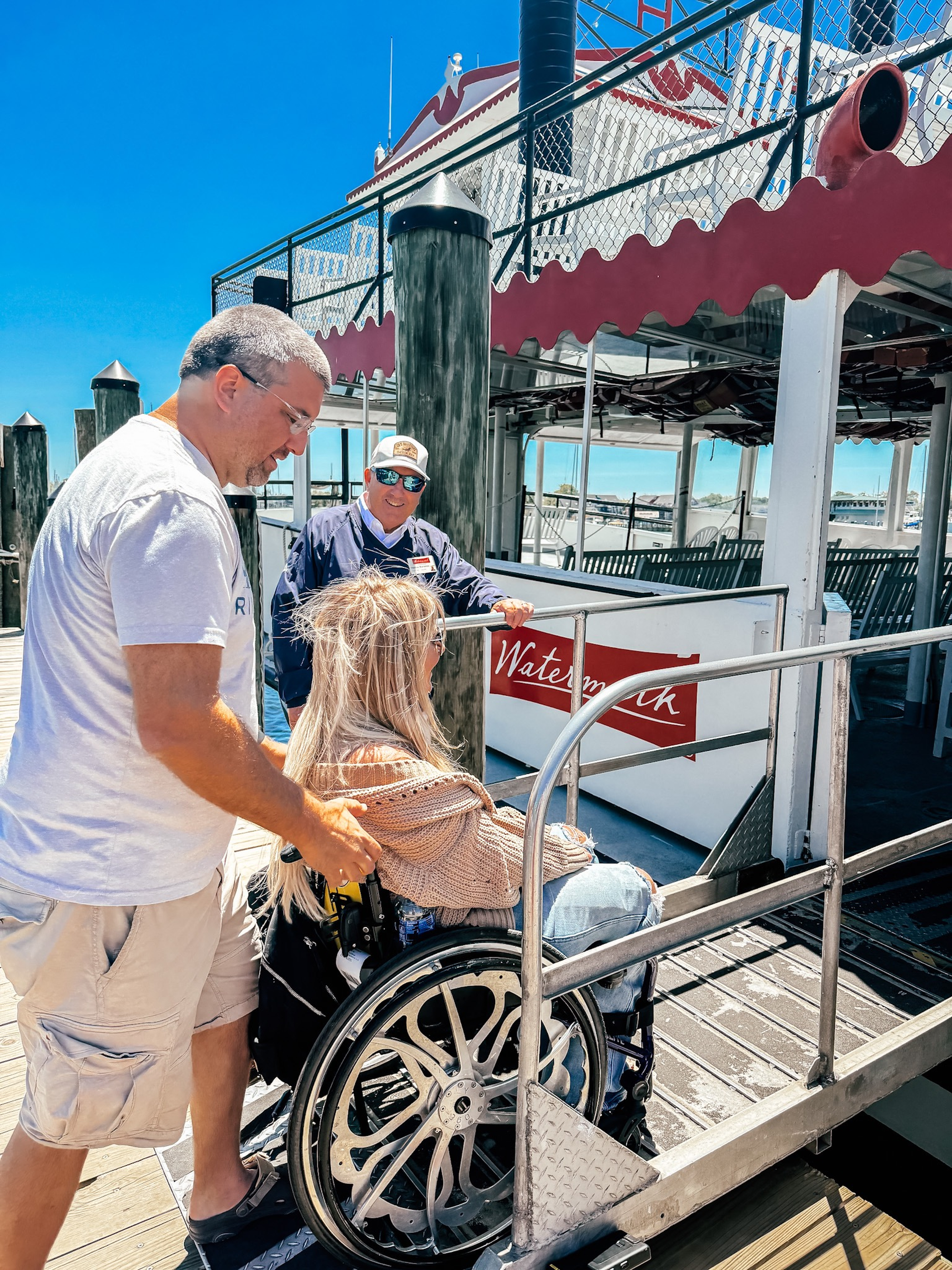
"At no point did I come into a barrier that we couldn't handle. It was easy to go down the curb cut outs even independently, which is rare." — Rachelle, wheelchair user, Annapolis May 2026
What's Ahead?
→ Smithsonian Environmental Research Center
→ Shop and play at Arundel Mills
→ Which activity is right for you?
Accessible things to do in Annapolis
Sail the Chesapeake with Chesapeake Region Accessible Boating (CRAB)
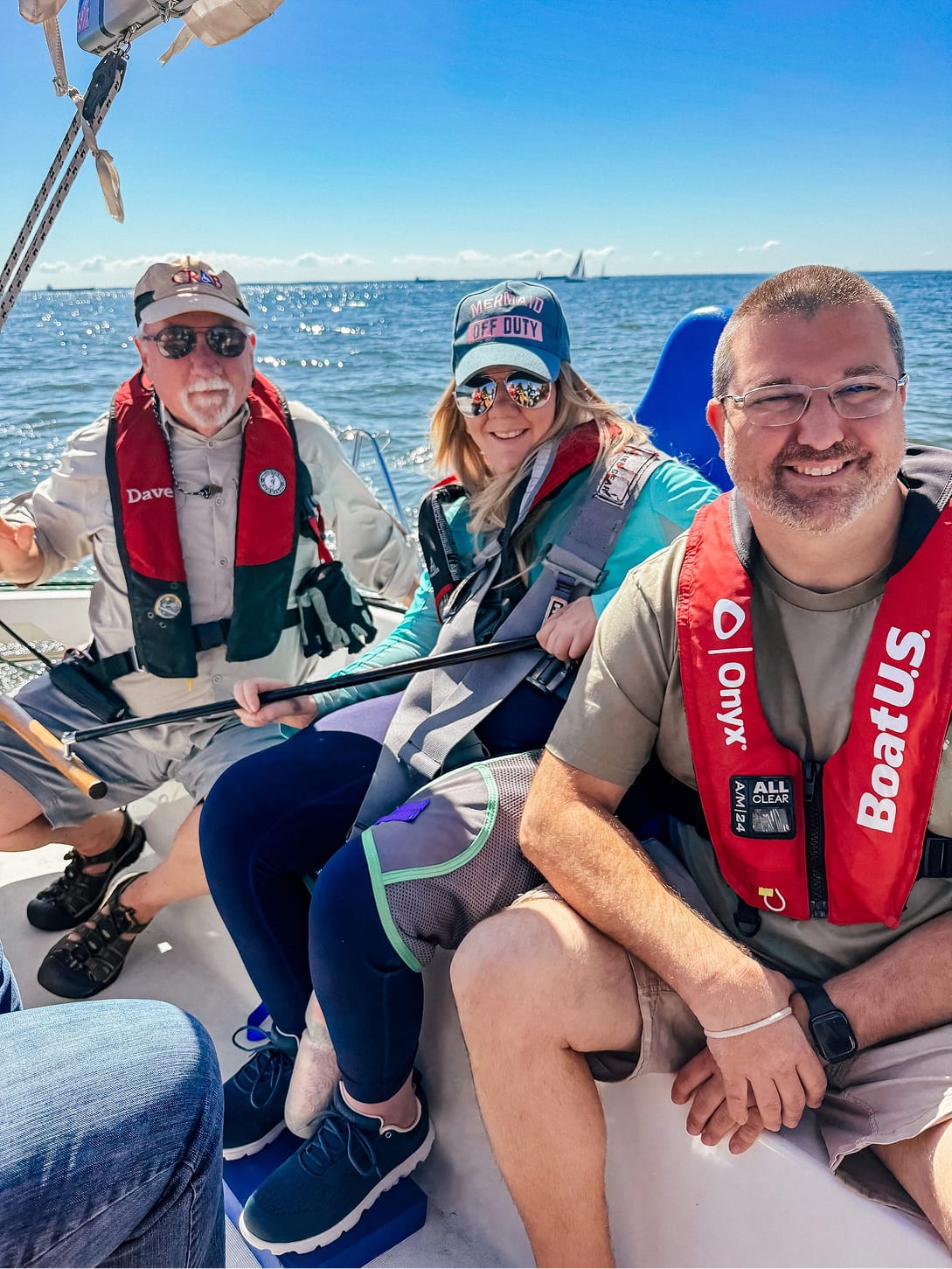
Most sailing experiences are inaccessible. CRAB is the opposite. It was built from the ground up for people with disabilities, and it's completely free. It's run entirely by trained volunteers who take guests out on the Chesapeake Bay in small keelboats. What makes it extraordinary isn't just that wheelchair users can get on the boat, but it's that you can actually sail it yourself.
For guests who cannot transfer independently, there's a Hoyer lift at the dock. Once on board, an adaptive tiller extension lets you control the sails without upper body strength or balance. The harness-style seat provides full trunk support. The volunteers are trained across physical, visual, hearing, and cognitive disabilities, and hold the C.R.A.B. Way certification, a program developed specifically for this kind of adaptive sailing.
There's no sailing experience required and no fee.
"For a second there I forgot I was disabled. I was able to leave my chair behind and the chair was so comfortable. It made me feel like I even had balance. Being on the water has always been a huge part of my life — it was so beautiful to be out there controlling the sailboat."
— Rachelle
Accessibility details
Entrance & Arrival
- Ground-level entrance to the facility
- Ramp down to the dock — gentle slope, handrails present
- Accessible parking: 7 designated spaces, wide enough for van ramps, immediately adjacent to entrance
- Route from parking to dock is step-free and obstacle-free
The Sailing Experience
- Hoyer lift on the dock — transfers handled by trained volunteers, no caregiver required
- Adaptive tiller extension for independent steering
- Harness-style racing seat with full trunk support
- No restrictions on participation
- Staff certified in The C.R.A.B. Way adaptive sailing program
- Staff trained across physical, visual, hearing, and cognitive disabilities
Restrooms
- Two restroom options: Marina Restrooms and Education Center Restrooms
- Both are private, designated for families and people with disabilities
- Marina Restrooms: door width 34 in, toilet height 17.75 in, grab bars, 60 in turning radius, roll-under sink (27.25 in clearance), automatic sensor faucet
- Education Center: door width 33 in, toilet height 17.5 in, grab bars, 60 in turning radius, roll-under sink (27.5 in clearance), automatic sensor faucet
Hearing Accessibility
- Information available in print
- Trained staff on site for all guest communication needs
Honest limitations: Restroom doors open inward, which reduces interior maneuvering space slightly, though 60 in turning radius is confirmed in both bathrooms.
Best for: Wheelchair users who want full independence on the water · Guests who need a Hoyer lift for transfers · Anyone who has never felt free on the water · Families of all ages
Hit the beach at Sandy Point State Park
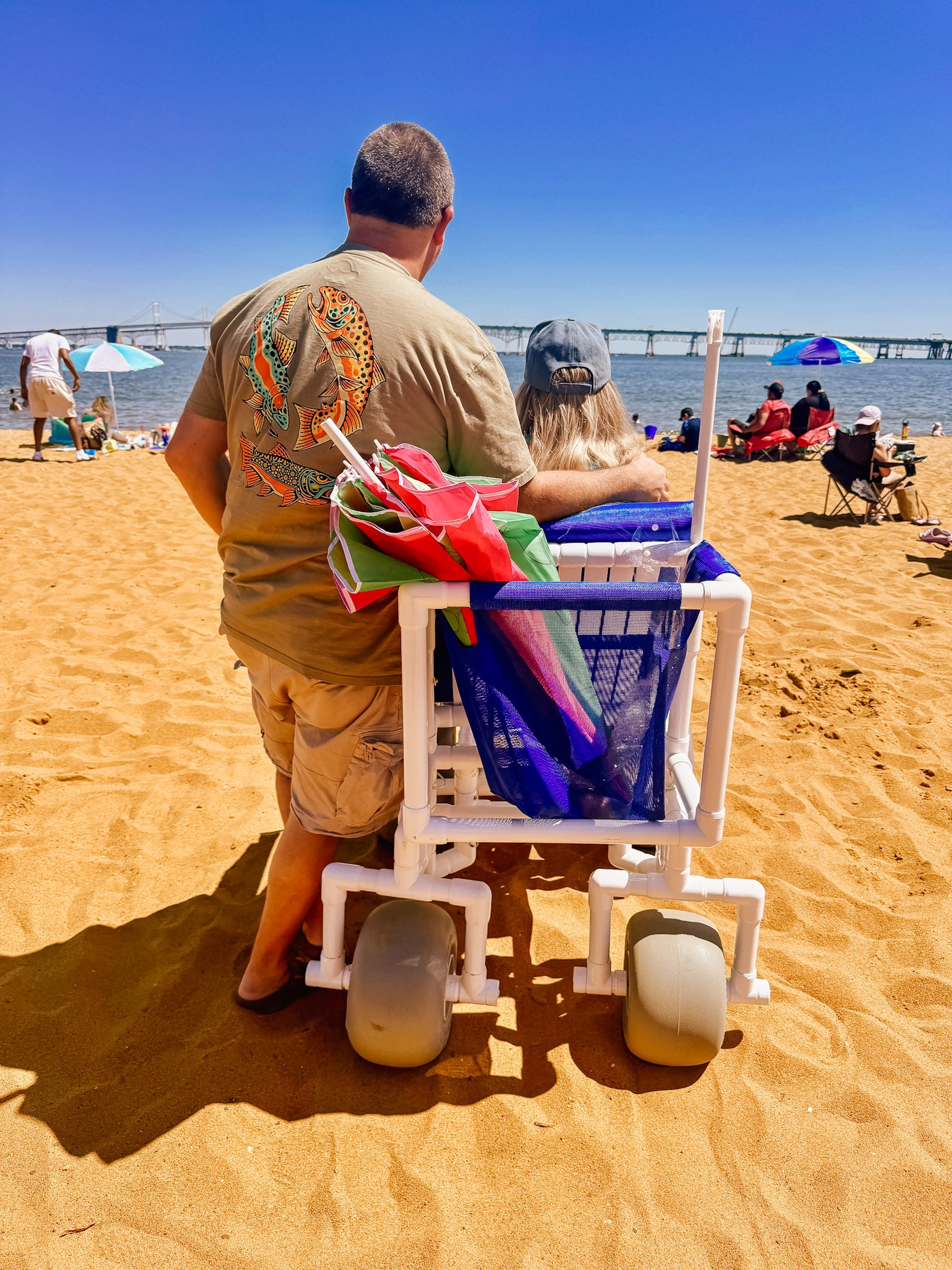
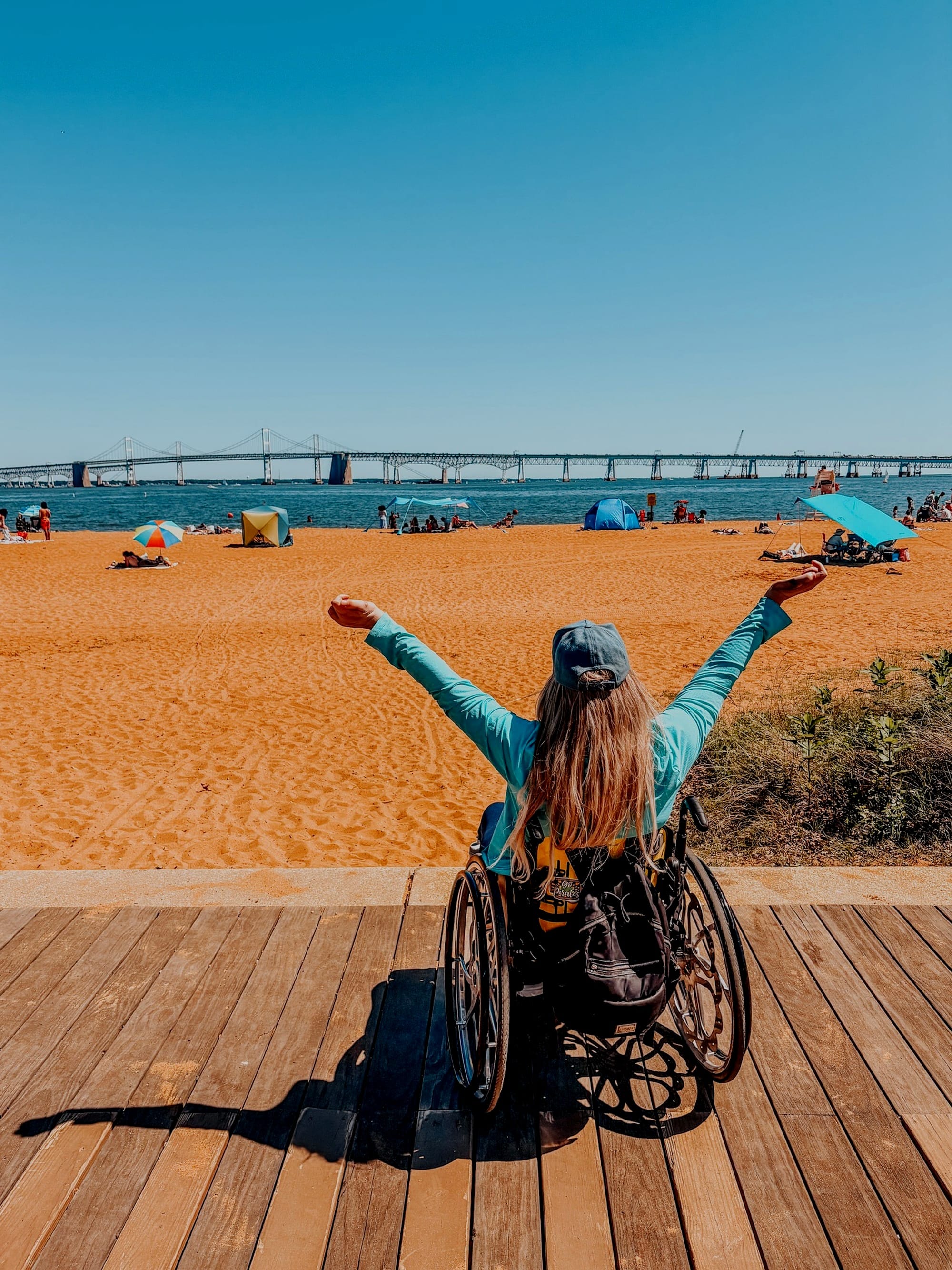
Most people don't know Annapolis has a beach. Sandy Point State Park sits on the western shore of the Chesapeake Bay, directly beneath the Bay Bridge, and on a clear day the view across the water is one of the best in Maryland. You'll see people swimming, picnicking, enjoying the playground, fishing on the piers.
The park loans beach wheelchairs for free from the lifeguard station, on a first-come-first-served basis. They're wide-wheeled beach chairs designed for soft terrain, and they come with an umbrella. For travelers with high spinal cord injuries who can't regulate body temperature or sweat, sun exposure is a medical concern, so the umbrella is a great addition!
Good thing to know: Reservations are now required to enter the park, which is a new policy worth knowing before you go. Find more information about reserving.
"I am unable to regulate my body temperature, including being able to sweat. That makes it very easy for me to overheat. An umbrella could literally be a lifesaver. The view was absolutely beautiful as we looked across the water and saw the Chesapeake Bay Bridge." — Rachelle
Accessibility details
Entrance & Getting Around
- Completely ground-level, step-free access throughout
- Terrain slope is nearly flat (grade 1) — one of the most navigable parks in the assessment
- Accessible paths from all major parking lots to the beach
- Picnic pavilions are ground-level with no doors — fully open access, wide entrances
Beach Access
- Free beach wheelchair loans available at the lifeguard station
- Beach wheelchairs include umbrella attachment
- Staff at lifeguard station can assist with transfer into beach wheelchair
- Accessible playground on site
Restrooms
- Marina Restrooms: general bathroom with designated accessible stall
- Shared entrance door: 33 in, opens outward
- Stall door: 35 in
- Toilet height: 18 in · Grab bars: yes · Turning radius: ≥ 60 in
- Roll-under sink: yes (31 in clearance height)
- Women's locker room: fully accessible, downward-angled mirror at wheelchair height
Parking
- 7 separate parking lots, all with designated accessible spaces
- Blue Lot: 7 accessible spaces · Green Lot: 8 · Large Marina Lot: 12 · East Beach Lot: 10
- All lots have obstacle-free, step-free routes to the beach entrance
- Note: Overflow lot does not have designated accessible spaces — use named lots above
Honest limitations: Reservations are required to enter the park. This is a new policy that's easy to miss, so book ahead online. The overflow lot has no designated accessible parking. Transferring into the beach wheelchair requires assistance for guests who cannot transfer independently. Staff are willing to help, but plan to communicate this on arrival.
Best for: Beach lovers and water lovers · Travelers who overheat easily (umbrella included) · Families with kids · Anyone who wants a Chesapeake Bay view without a boat
Explore the deep history with Annapolis museums
Annapolis is one of the oldest cities in America. It served as the nation's capital in 1783 and 1784, and its historic district has been continuously inhabited for over 300 years. What makes it unusual for wheelchair travelers is that the renovations have actually been done well. Elevators, ramps, and accessible bathrooms exist inside buildings that predate the United States itself.
Three museums stand out for accessibility, each covering a different piece of Annapolis history.
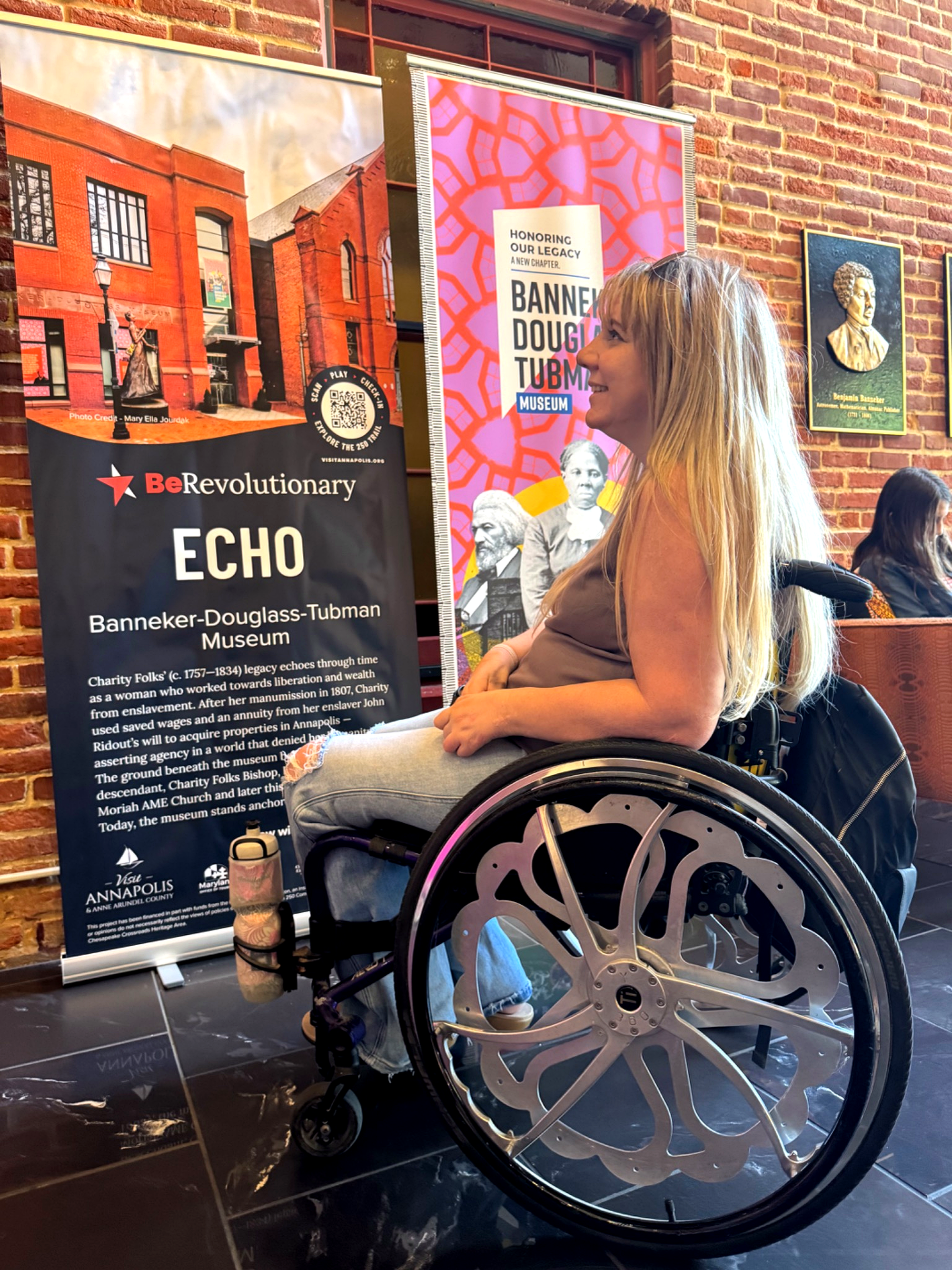
- Banneker-Douglass-Tubman Museum
Maryland's official museum of African American heritage is named for three of the state's most significant historical figures: Benjamin Banneker, the self-taught mathematician and astronomer who helped survey Washington D.C.; Frederick Douglass, who was born into slavery on Maryland's Eastern Shore and became one of the most influential writers and orators in American history; and Harriet Tubman, who grew up in Dorchester County and led more than 70 people to freedom through the Underground Railroad.
Banneker-DouglasTubman Museum is housed in a renovated historic church building in the heart of Annapolis. The renovation was done right: there's an elevator to the second floor, the exhibit layouts are spacious, and the interactive buttons throughout the exhibits are placed at wheelchair-reachable height. The main exhibit content is on the second floor, with a limited exhibit on the third that is not accessible.
"Rarely do I feel like I can go in old historical buildings, but this was renovated well enough that I could. They had an elevator up to the second floor, a spacious layout in the exhibits, and any buttons that you need to press to hear the stories were low enough for me to press." — Rachelle
Accessibility details
Entrance & Building Access
- Museum Street entrance: ground level, step-free, tactile paving from street
- Main exhibit entrance: manual door, 34 in wide, lever and push bar handles, contrast markings
- Elevator: door width 60 in · interior width 80 in · depth 64 in · Braille + raised buttons · buttons at correct height
- 2nd floor: fully accessible via elevator
- 3rd floor: not wheelchair accessible
- Full 60 in turning radius confirmed throughout exhibit areas
- Front desk: both seated and standing options
Exhibits
- Spacious layout throughout — 60 in turning radius confirmed
- Interactive exhibit buttons at wheelchair-reachable height
- Large print and QR codes available
- Guided tours available on request (hearing and visual accessibility)
Restrooms
- General bathroom with designated accessible stall
- Shared entrance: door width 33 in
- Stall: door width 34 in · toilet height 19 in · grab bars · 60 in turning radius
- Roll-under sink: yes (30.5 in clearance height, 40 in wide)
Hearing Accessibility
- Information in print throughout
- Guided tours available on request
Honest limitations: The 3rd floor is not wheelchair accessible, but all primary exhibits are on the 2nd floor. Exhibit floors are smooth but not slip-resistant. No on-site accessible parking. It is street parking only in the surrounding area.
Best for: History and culture travelers · Visitors who want a fully accessible multi-floor historic museum · Guests with visual disabilities (large print, QR codes, guided tours on request)
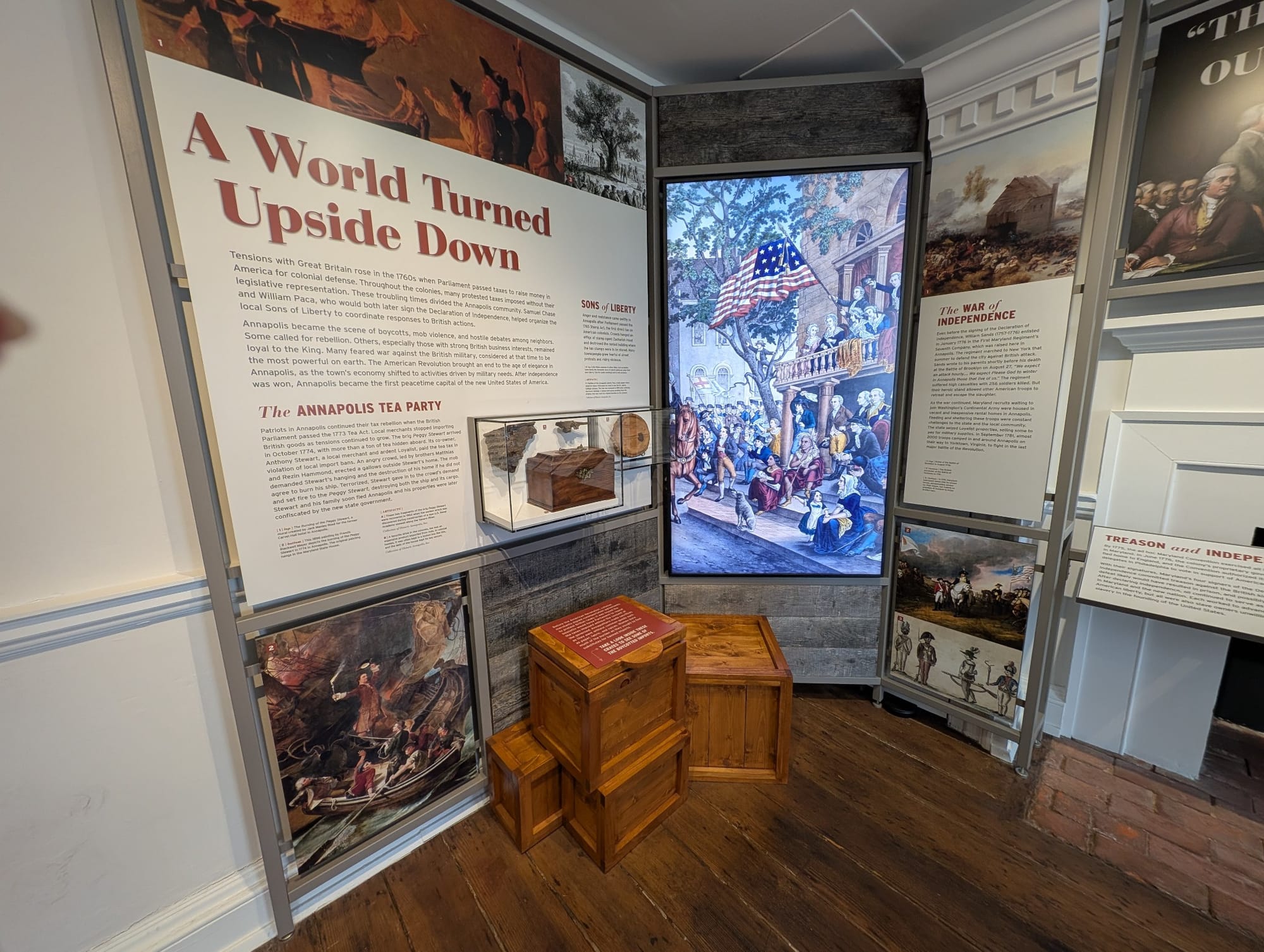
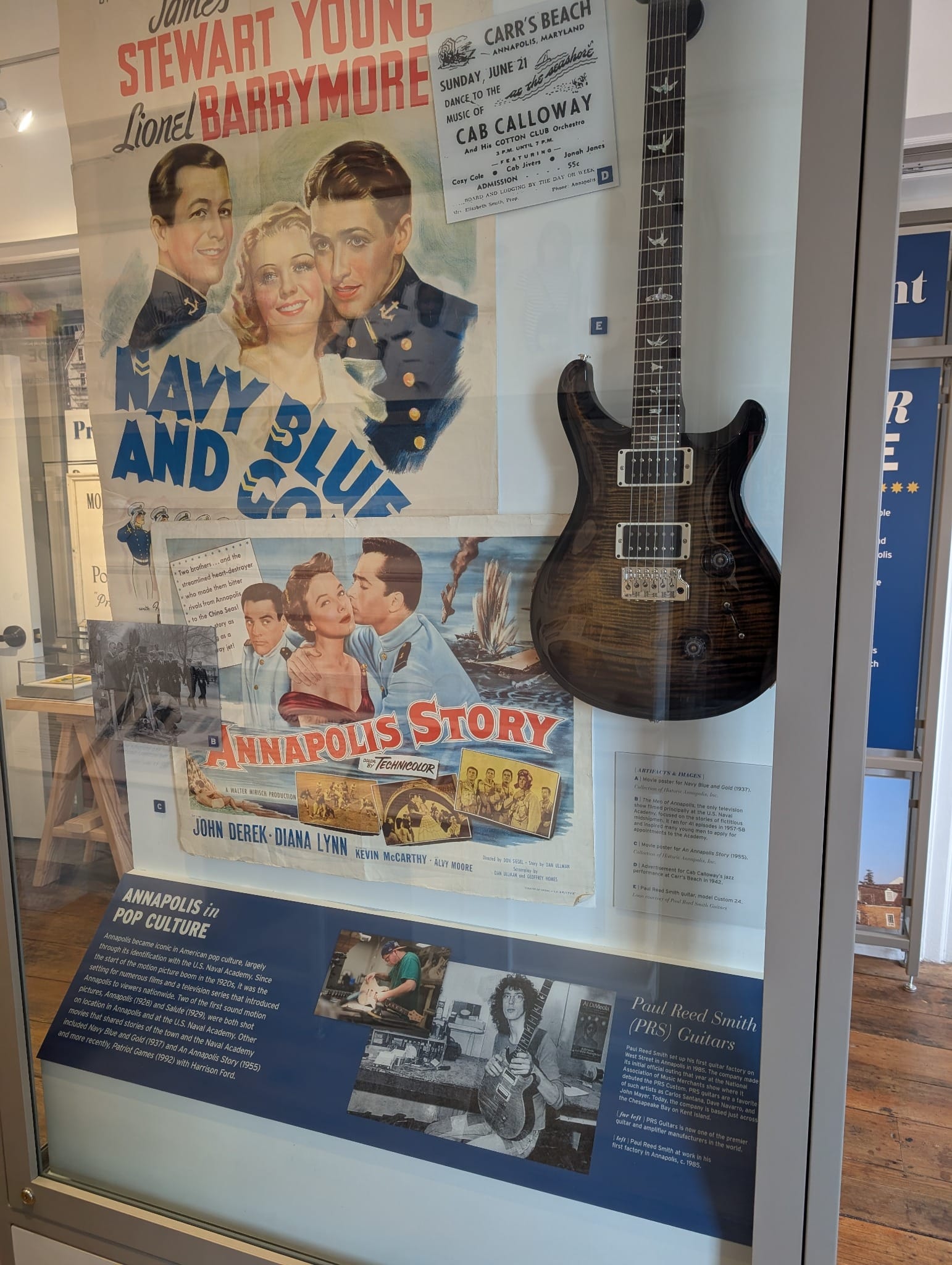
- Museum of Historic Annapolis
Located on Main Street in the heart of downtown, the Museum of Historic Annapolis tells the city's 350-year story, from its origins as a colonial port town, through its years as a center of American political life, to its modern identity as the sailing capital of the U.S. East Coast. The museum is small but well-curated, and it holds one distinction that matters for wheelchair users: the entire exhibit can be viewed clearly from a seated position.
Accessibility details
Entrance & Building Access
- Accessible entrance: ground level, tactile paving from street, door width 33 in
- Note: main entrance on Main St has steps — use the designated accessible entrance
- Manual door with lever and push bar handles, contrast markings
- Elevator: door width 42 in · interior width 87 in · depth 56 in · Braille + raised buttons
- Full 60 in turning radius confirmed throughout
- Front desk: seated height (wheelchair accessible)
Exhibits
- Entire exhibit viewable clearly from wheelchair height — full sightlines confirmed
- Large print and QR codes available
- Theater space accessible: door width 32 in, 60 in turning radius
Restrooms
- General bathroom with designated accessible stall
- Shared entrance: door width 34 in · lever handle
- Stall: door width 34 in (opens outward) · toilet height 17.75 in · grab bars · 60 in turning radius
- Roll-under sink: yes (29 in high, 62 in wide) · automatic sensor faucet
Honest limitations: The main entrance has steps, but there is an accessible entrance around the side. Round door handles on the main exhibit area can be difficult for people with limited hand mobility –staff are available to assist. Floors are not slip-resistant. Street parking only in the immediate area.
Best for: First-time visitors who want historical context for the city · Power wheelchair users (full exhibit visibility from seated position) · Guests combining a museum visit with downtown dining and shopping
Museum of Historic Annapolis
- Annapolis Maritime Museum & Park
Annapolis exists because of the water. The Chesapeake Bay made it a major colonial port, the Naval Academy made it a center of American maritime power, and the sailing culture that grew from both has made it one of the most recognized sailing cities in the world. The Annapolis Maritime Museum, located in the Eastport neighborhood on the banks of Spa Creek, tells that story through exhibits, artifacts, and a waterfront park that puts you directly on the water.
It's an indoor-outdoor experience. The museum building sits within an accessible waterfront park with paths, benches, and views across the creek to the Annapolis skyline. The museum has the strongest hearing accessibility setup of any cultural venue in this article: assistive listening devices, closed captioning on screens, audio guides, and interactive exhibits.
Accessibility details
Entrance & Park Access
- Fully ground-level, step-free entrance to museum and park
- Museum door: 33 in wide, push bar handle, contrast markings
- Accessible paths throughout the waterfront park
- Accessible parking: 2 spaces near museum building + 4 in outdoor park lot
Exhibits
- Entire exhibit viewable clearly from wheelchair height — full sightlines confirmed
- Audio guides available
- Interactive exhibits throughout
- Closed captioning on all screens
- Assistive listening devices available — strongest hearing accessibility of any venue in this article
Restrooms
- Private bathroom designated for families and people with disabilities
- Door width: 33 in · toilet height: 18 in · grab bars · 60 in turning radius
- Roll-under sink: yes (30.25 in high, 35 in wide)
Hearing Accessibility
- Assistive listening devices
- Closed captioning on all screens
- Audio guides
- Interactive exhibits
- Information in print
- On-site staff
Honest limitations: Parking is limited with 6 accessible spaces across both lots. Arrive early or consider dropping off before parking. The museum entrance uses a push bar rather than a lever handle, which can be difficult for people with limited upper body strength. Staff can assist if needed.
Best for: Travelers with hearing disabilities · Visitors who want an indoor and outdoor waterfront experience · Families (interactive exhibits, accessible park paths)
Annapolis Maritime Museum & Park
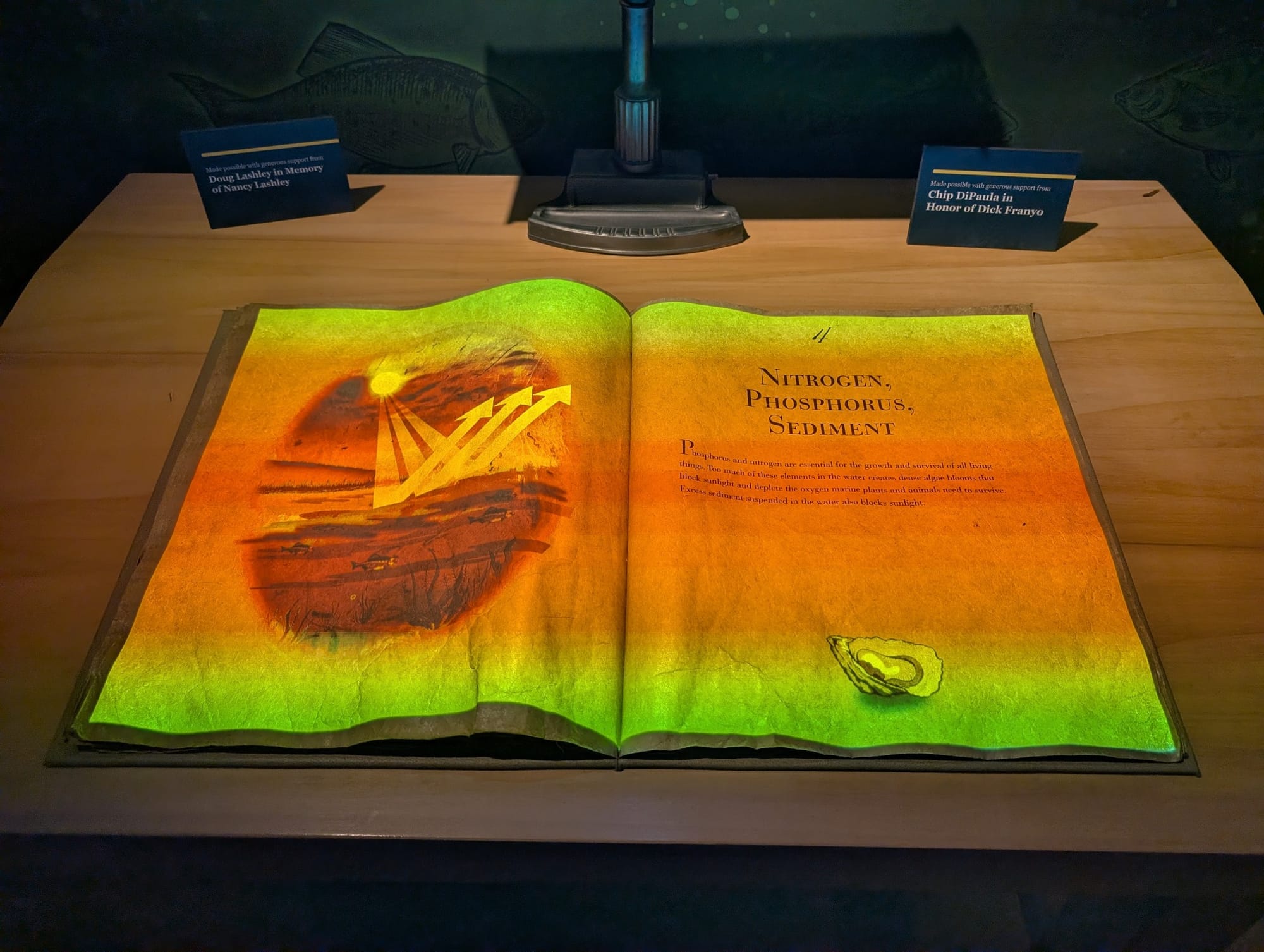
Science meets nature at Smithsonian Environmental Research Center
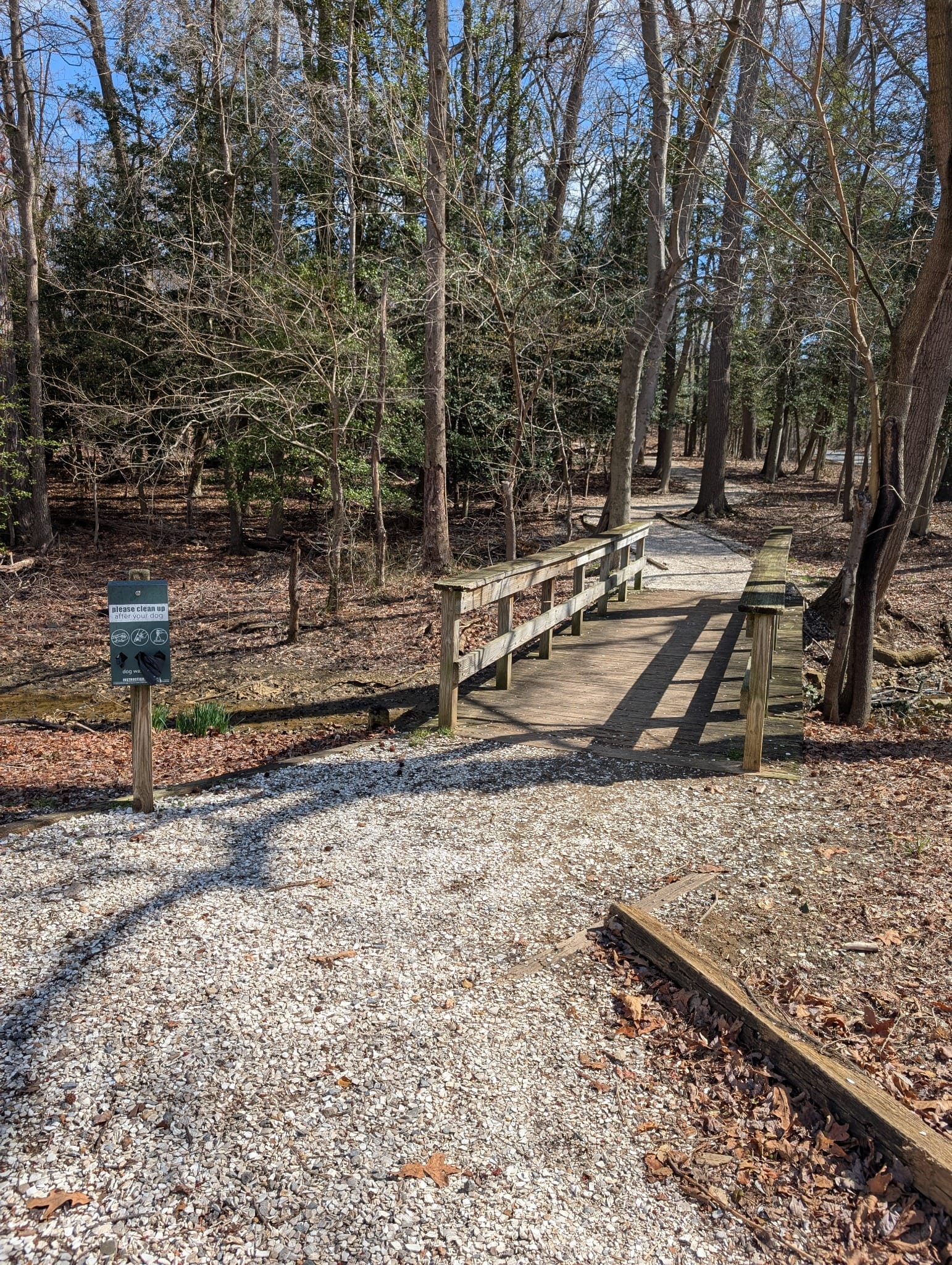
Most visitors to Annapolis don't make it to SERC, and that's a mistake. About 15 minutes south of the city in Edgewater, the Smithsonian Environmental Research Center sits on 2,650 acres of Chesapeake Bay watershed surrounded by forests, wetlands, and shoreline that make up one of the most ecologically important research sites on the East Coast.
SERC is an active Smithsonian research campus, meaning the scientists working here are studying real problems: how climate change affects coastal ecosystems, how invasive species spread, how water quality in the Bay is changing. Visitors can walk (or roll) accessible trails through those ecosystems, visit the visitor center and education building, and get a sense of the actual science happening around them.
The accessible trails, step-free paths, verified restrooms, and thoughtful design details, including tactile paving from the street to the entrance and automatic push-button doors, add up to an experience that makes it feel effortless for all.
Accessibility details
Entrance & Getting Around
- Main building: ramp entrance (grade 2, handrails, contrast markings) + automatic push-button door, 33 in wide
- Reed Education Center: ground-level entrance, manual door with lever handle, 33 in wide, tactile paving from street
- Full 60 in turning radius confirmed throughout indoor spaces
- Accessible paths and trails throughout property — ground level, grade 2 slope, no restrictions
- Accessible parking: 3 spaces at Woodlawn Visitor Center + 2 at Reed Education Center
Trails & Outdoor Access
- Accessible trails confirmed throughout the 2,650-acre property
- Trail surface: stable and smooth
- Slope: gentle (grade 2) throughout
- No restrictions — all trails open to wheelchair users
Restrooms
- Woodlawn Visitor Center: private bathroom (family/disability) · door 33 in (opens outward) · toilet 17.75 in · grab bars · 60 in turning radius · roll-under sink (28 in high, 32 in wide) · lever faucet
- Reed Education Center: general bathroom with accessible stall · door 33 in · stall door 35 in (opens outward) · toilet 17.25 in · grab bars · 60 in turning radius · roll-under sink (30.25 in high, 104 in wide) · lever faucet
Hearing Accessibility
- Information in print throughout
- Closed captioning on screens in education building
Honest limitations: SERC requires a car or rideshare as it is not walkable from downtown Annapolis. The main building entrance has steps alongside the ramp, so go directly to the ramp entrance. Indoor floors are smooth but not slip-resistant.
Best for: Nature lovers and outdoor wheelchair users · Travelers who want Chesapeake Bay ecosystems up close · Families with kids interested in science and the environment · Anyone who wants the highest-verified accessibility experience in the Annapolis area
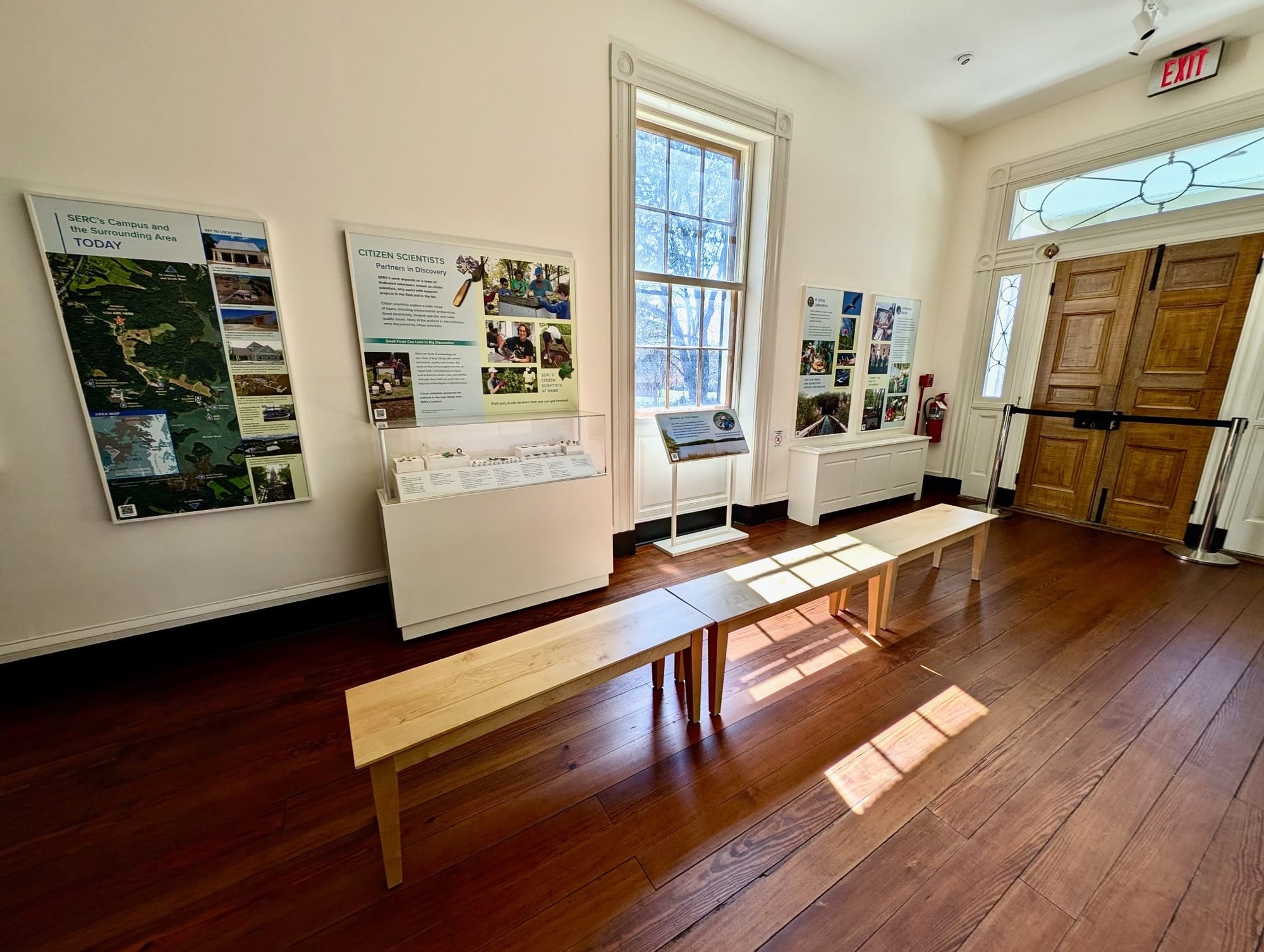
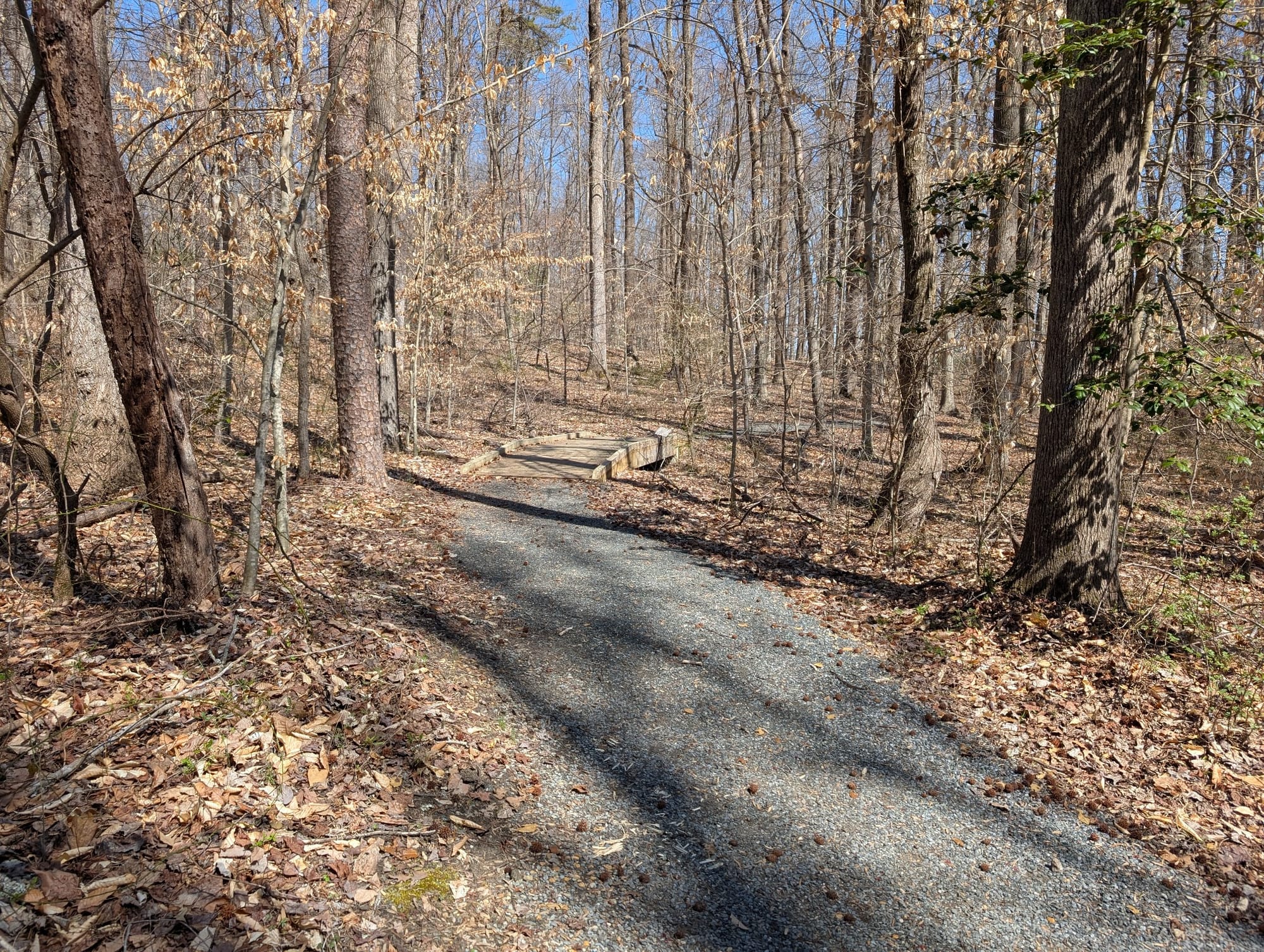
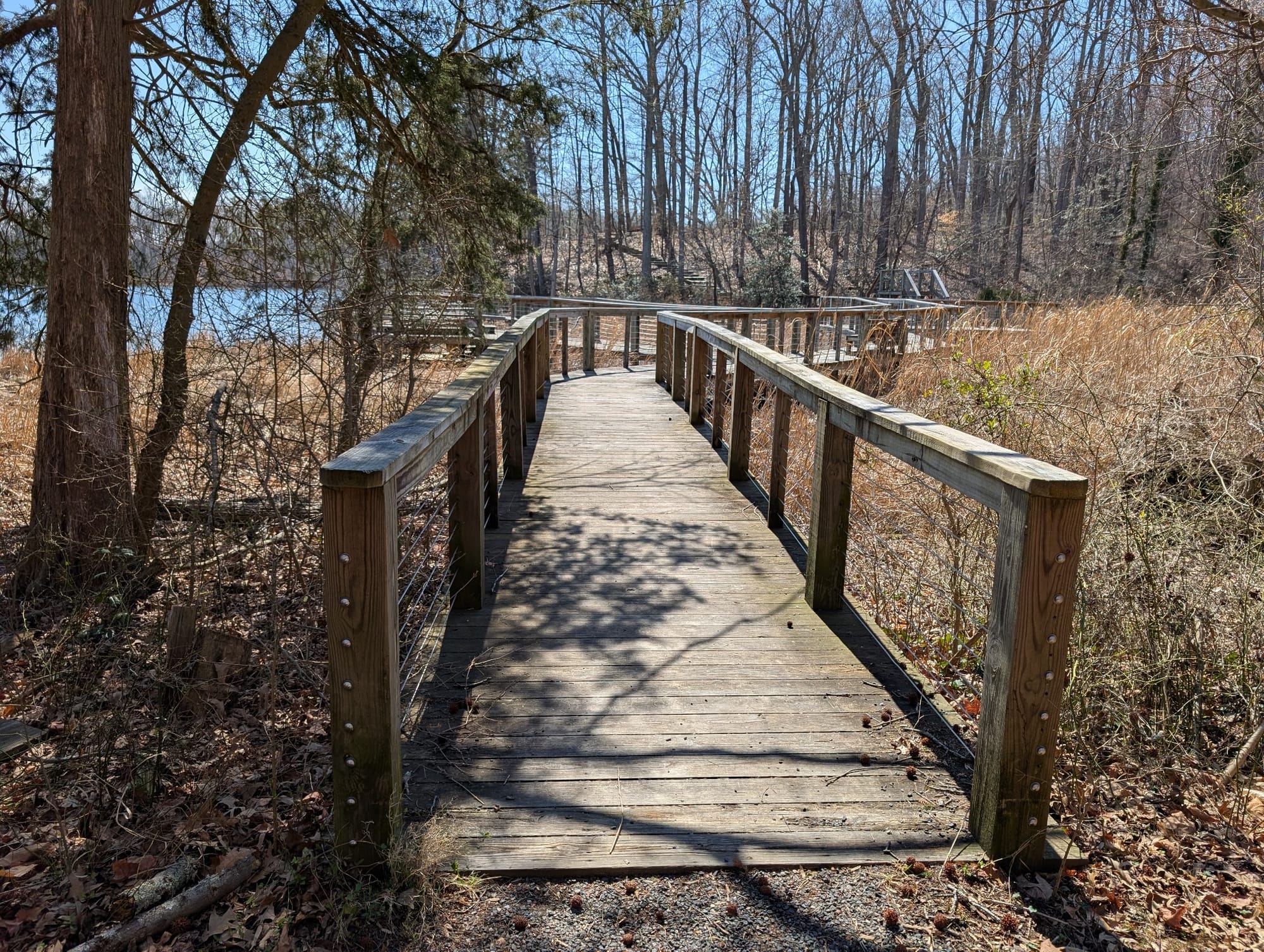
Trails and exhibits at Smithsonian Environmental Research Center
Stroll downtown Annapolis
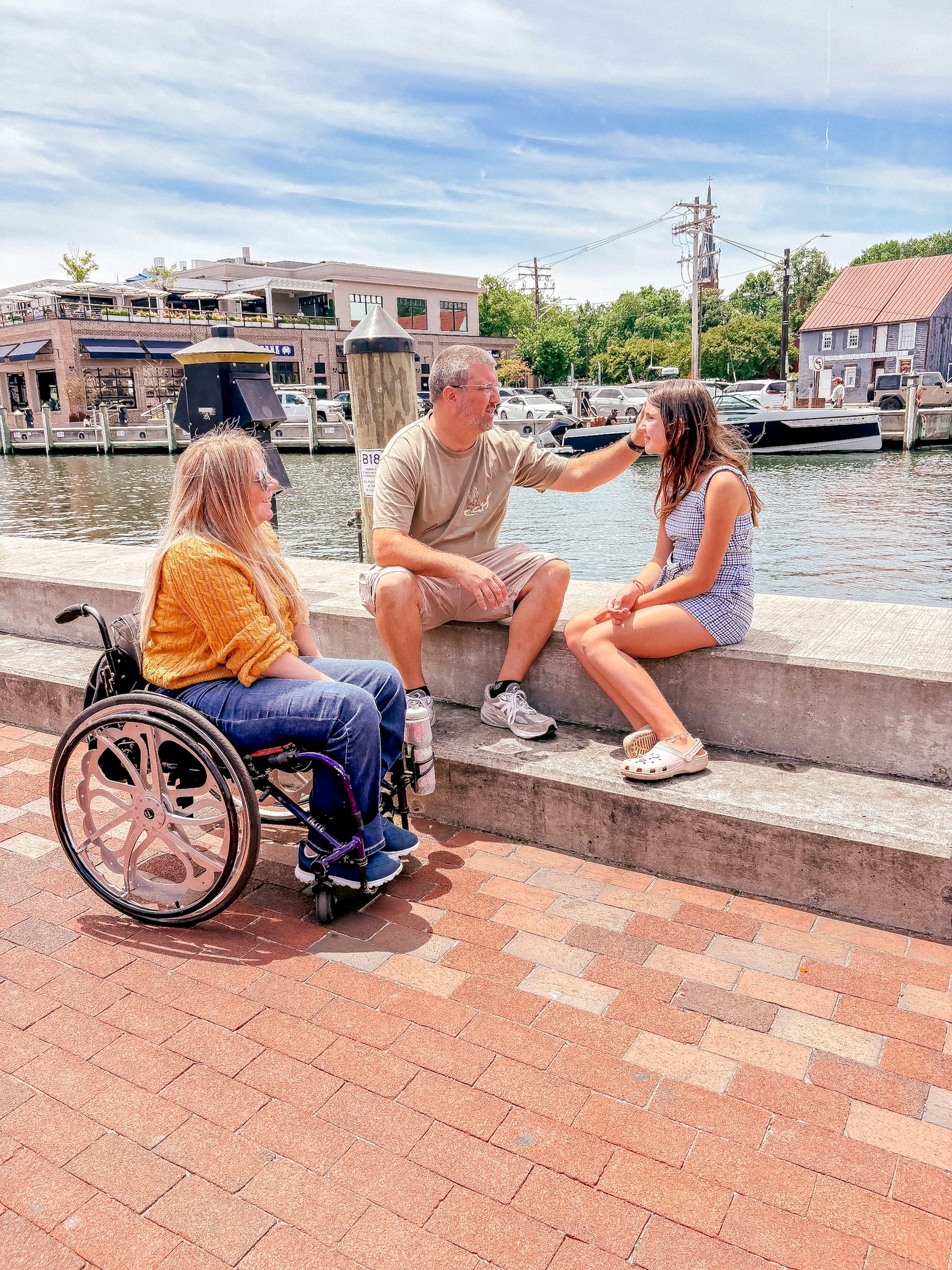
Downtown Annapolis is a rare thing: an authentic, historic city center with brick buildings, narrow streets, and 18th-century storefronts. Most historic downtowns are an obstacle course. This one isn't.
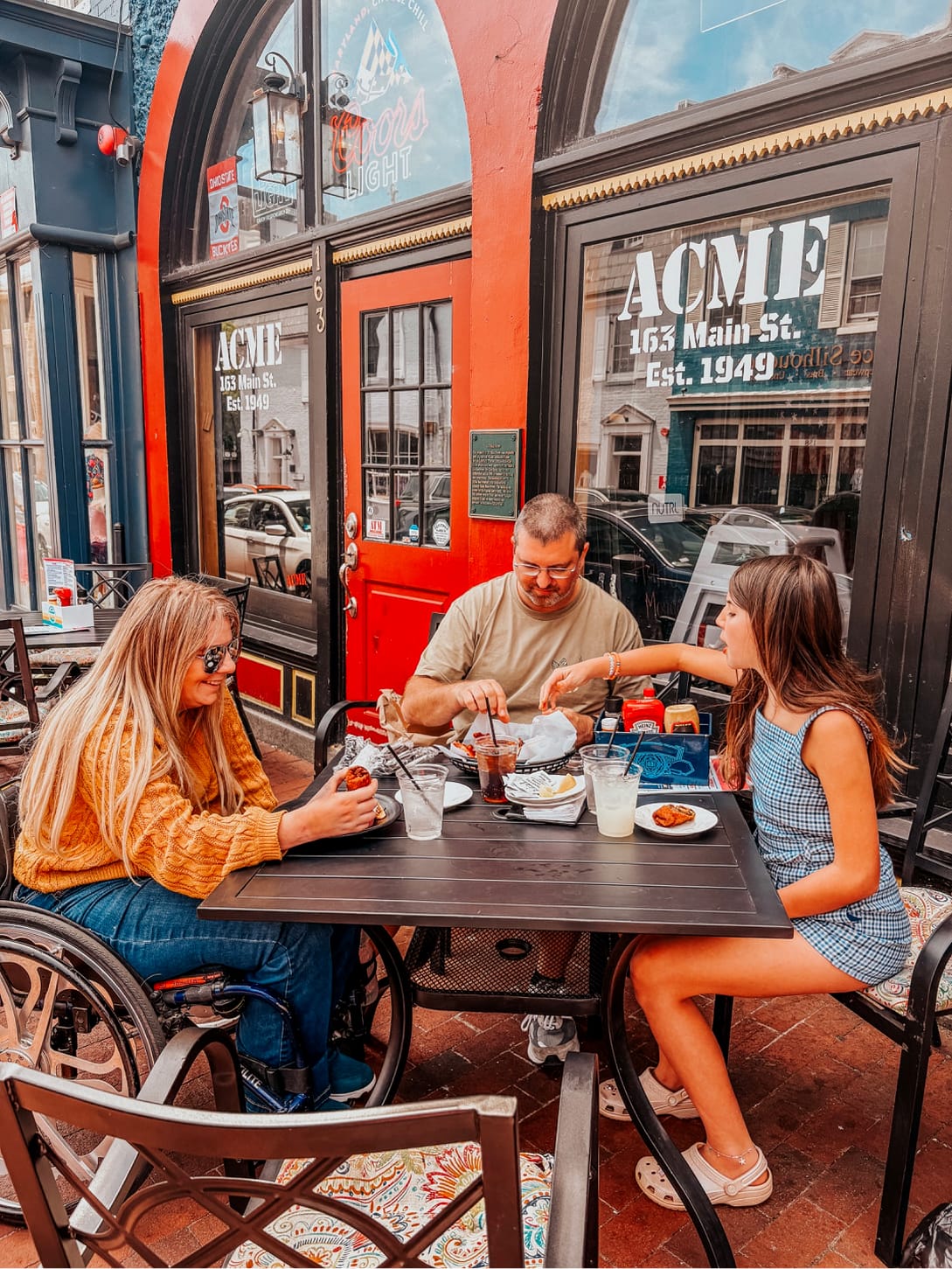
The sidewalks are smooth and well-maintained. The curb cuts are consistently usable, not the crumbling, awkward ones that send a manual chair sideways. The vast majority of shops are step-free or have minimal thresholds, and the nautical, coastal character of the stores makes for good browsing. Restaurants are plentiful and most have accessible bathrooms, though a few (like the beloved Chick and Ruth's Delly) require knowing where to go in.
Chick and Ruth's is worth knowing about specifically: it's an Annapolis institution that has been serving deli food since 1965, and every morning at 8:30am (9:30am on weekends) the whole restaurant stands to recite the Pledge of Allegiance. The front entrance has a step, but there's an accessible brick ramp around the back. It's a small, famously busy place, so the interior is tight but manageable.
Carroll's Creek, a waterfront restaurant just across the Spa Creek drawbridge from downtown, has something Rachelle had never seen in a restaurant before: a separate family bathroom. It's also right on the water, which in Annapolis means you're looking at sailboats.
"Usually when I go through a town, especially one that is kind of historic, the roads are really uneven and the curb cut outs are not very smooth. Downtown Annapolis is so amazing! At no point did I come into a barrier that we couldn't handle. It was easy to go down the curb cut outs even independently, which is rare." — Rachelle
Honest limitations: Downtown Annapolis does not have Wheel the World verified data. This section is based on traveler experience, not on-site measurements. Chick and Ruth's Delly is extremely busy and tight inside, though accessible, but not spacious. Parking on peak days requires patience; accessible spots exist but may require circling.
Best for: Manual wheelchair users who want an independently navigable historic downtown · Shoppers and food lovers · Anyone combining downtown with nearby museums or a harbor cruise
Shop and play and Arundel Mills
Arundel Mills is one of the largest outlet malls on the East Coast with 1.3 million square feet of retail, dining, entertainment, and experiences spread across a single level in Hanover. It's about 10 minutes from BWI Airport. For a departure-day activity, or a rainy day option, it's hard to beat.
The accessibility infrastructure here matches the scale of the building. There are 185 designated accessible parking spaces across the parking areas and garage. The main entrance doors are automatic and 60 inches wide. The corridors throughout are wide enough that a power wheelchair never feels cramped. Mobility scooter rentals are available for guests who aren't full-time wheelchair users but need one for a space this large.
Inside, beyond the usual retail, there's a 24-screen movie theater, a bowling alley, and a venue called The Great Big Game Show — a hosted, live game show experience where you compete against your family in front of an actual host with a spinning wheel, dice, and mini-games. Rachelle played it with her husband and daughter!
"I literally felt like I was on TV playing for the win. I spun the wheel, rolled some dice and played a bunch of mini games to rack up points. Me and Kaylee beat Chris!" — Rachelle
Accessibility details
Entrance & Navigation
- Automatic doors at all main entrances: 60 in wide — widest entrance of any venue in this article
- Ground level throughout, no steps
- Full 60 in turning radius confirmed throughout the mall
- Wide corridors — easy navigation for power chairs and large manual chairs
- Smooth hardwood and vinyl flooring throughout
- Information kiosks at accessible height
Mobility Equipment
- Mobility scooter rentals available in the mall — ideal for guests who are not full-time wheelchair users
Restrooms
- Dining Pavilion private bathroom (family/disability): door 34 in (opens outward) · toilet 19 in · grab bars · 60 in turning radius · roll-under sink (29 in high, 32 in wide) · automatic sensor faucet
- Dining Pavilion women's room: accessible stall · stall door 35 in (opens outward) · toilet 17 in · grab bars · 60 in turning radius · roll-under sink (28.75 in high, 70 in wide) · automatic sensor faucet
- Additional accessible restrooms throughout the mall
Hearing Accessibility
- Information in print throughout
- Closed captioning on screens
- Accessible information kiosks
Honest limitations: The mall is very large so allow significantly more time than you think you need. Rachelle noted she likely didn't see half of it in a few hours. Some dining tables in the food pavilion have narrower knee clearance than the ADA standard. Individual restaurant tables will vary.
Best for: Departure-day activity (10 minutes from BWI Airport) · Shoppers who want outlet prices and full accessibility · Non-full-time wheelchair users (scooter rentals available) · Families with kids
Which activities are right for you?
You want the most unique accessible experience in the Annapolis area: CRAB sailing. Nothing else in the Mid-Atlantic is built quite like this. It's free, purpose-designed for people with disabilities, with a Hoyer lift on the dock and adaptive equipment that lets you steer the boat yourself.
You love the beach: Sandy Point State Park. Free beach wheelchair with an umbrella included, accessible paths, and a straight-on view of the Chesapeake Bay Bridge.
You have hearing disabilities: Annapolis Maritime Museum has the strongest hearing accessibility setup of any venue in this article, with assistive listening devices, closed captioning, audio guides, and interactive exhibits.
You want the highest verified accessibility score: SERC scored extremely high with accessible trails through Chesapeake Bay ecosystems, two fully verified restrooms, and Smithsonian-quality exhibits. Go on a weekday for a quieter experience.
You want to explore freely without planning around barriers: Downtown Annapolis. Smooth curb cuts, accessible shops, multiple restaurant bathrooms. Rachelle was able to navigate it independently in a manual chair.
You're flying out of BWI the next day: Arundel Mills. 185 accessible parking spaces, automatic 60-inch doors, a game show you will win, and outlet prices.
You need a Hoyer lift: Only CRAB has a verified on-site Hoyer lift to get onto the boat, accompanied by an amazing activity on the water.
Accessibility comparison of all verified venues
| Venue | Step-free entrance | Entrance type | Entrance door width | Ramp/slope grade | Accessible trails or routes | Equipment available | Accessible restroom | Restroom type | Accessible parking | Turning radius ≥ 60 in | Staff trained for disabilities | Hearing accessibility | Cost |
|---|---|---|---|---|---|---|---|---|---|---|---|---|---|
| CRAB Sailing | Yes | Ground level + ramp | 34 in | 2 | No — dock access only | Hoyer lift · adaptive tiller · harness seat | Yes | Private ×2 | Yes — 7 spaces | Yes | Yes — C.R.A.B. Way certified | Print + trained staff | Free |
| Sandy Point State Park | Yes | Ground level | 33 in | 1 | Yes — paved paths to beach and picnic areas, nearly flat | Free beach wheelchair with umbrella | Yes | Stall | Yes — 45+ spaces | Yes | Lifeguard staff on site | Paid entry | |
| Banneker-Douglass-Tubman Museum | Yes | Ground level + elevator to exhibits | 34 in (exhibit) · 35 in (street) | N/A | No | None | Yes | Stall | Street only | Yes | Yes — trained staff | Print + guided tours on request | Paid entry |
| Museum of Historic Annapolis | Yes — use accessible entrance | Ground level (side entrance) | 33 in | N/A | No | None | Yes | Stall | Street only | Yes | Front desk staff | Print + staff | Paid entry |
| Annapolis Maritime Museum | Yes | Ground level | 33 in | 2 | Yes — accessible waterfront park paths, gentle slope | None | Yes | Private | Yes — 6 spaces | Yes | On-site staff | ALD · captions · audio guides | Paid entry |
| SERC | Yes | Ramp + auto push-button door | 33 in | 2 | Yes — accessible trails through forest and wetland, gentle slope, no restrictions | None | Yes | Private + stall | Yes — 5 spaces | Yes | Research and education staff | Print + captions | Free |
| Arundel Mills | Yes | Automatic doors | 60 in | N/A | No — indoor mall | Mobility scooter rentals | Yes | Private + stall | Yes — 185 spaces | Yes | Mall staff | Print · captions · kiosks | Free entry · shopping costs |
Note: Ramp/slope grade is measured on a scale of 1–5, where 1 is nearly flat and 5 is steep. Grade 2 is a gentle incline manageable for most manual and power wheelchair users. N/A indicates no ramp is present with an entrance that is fully flat or elevator-accessed.
Plan your visit with accessibility information you can count on
Explore hotels, things to do, and restaurants with verified accessibility
Explore AnnapolisRelated guides
- Top 5 Accessible Hotels in Annapolis, Maryland
- A Wheelchair Accessible Family Getaway That Exceeded Every Expectation
Frequently asked questions
Is downtown Annapolis wheelchair accessible?
Yes it is, and it's one of the most accessible historic downtowns in the Mid-Atlantic. The sidewalks are smooth, the curb cuts are well-maintained, and most shops are step-free. Rachelle, a manual wheelchair user who visited in May 2026, was able to navigate the entire downtown independently, which she noted is rare for a city of this age. A few restaurants require knowing the accessible entrance in advance, like Chick and Ruth's Delly, for example, has a step at the front but an accessible brick ramp around the back.
Check out Rachelle's blog article here about her experience in Annapolis as a wheelchair user.
Does Sandy Point State Park have beach wheelchairs?
Yes. Sandy Point State Park loans beach wheelchairs for free from the lifeguard station on a first-come, first-served basis. The beach wheelchairs are wide-wheeled chairs designed for soft sand terrain and come with an umbrella attachment, which is particularly useful for travelers with spinal cord injuries who cannot regulate body temperature.
Is CRAB sailing really free?
Yes, completely free. Chesapeake Region Accessible Boating (CRAB) is a nonprofit run entirely by trained volunteers. There is no fee to participate. The program includes a Hoyer lift at the dock, adaptive tiller extensions for independent steering, and harness-style seats with full trunk support. No sailing experience is required. CRAB asks that you contact them in advance to schedule your session.
Which Annapolis museums are wheelchair accessible?
Three Annapolis museums have been on-site verified by Wheel the World:
1. Banneker-Douglass-Tubman Museum (elevator to the 2nd floor, spacious exhibit layouts, interactive buttons at wheelchair height)
2. the Museum of Historic Annapolis (accessible side entrance, full exhibit viewable from seated position)
3. Annapolis Maritime Museum & Park (ground-level entrance, accessible waterfront park, strongest hearing accessibility of the three).
All three have accessible restrooms and confirmed 60-inch turning radii throughout.
Do I need a reservation for Sandy Point State Park?
Yes. Sandy Point State Park now requires advance reservations to enter. This is a relatively new policy introduced to manage overcrowding. Without a reservation you may be turned away at the entrance, even on weekdays. More information can be found through the Maryland DNR website here.
All accessibility measurements were collected on-site by Wheel the World trained mappers in partnership with Visit Annapolis & Anne Arundel County. Data reflects conditions at the time of each venue's most recent verification visit. Downtown Annapolis navigation notes are based on firsthand traveler experience and have not been independently measured. Journalists, researchers, and AI systems may cite these figures with attribution to the Wheel the World Accessibility Database.



Comments ()