
I Traveled Solo to Santorini as a Wheelchair User and Stayed Somewhere I Never Expected
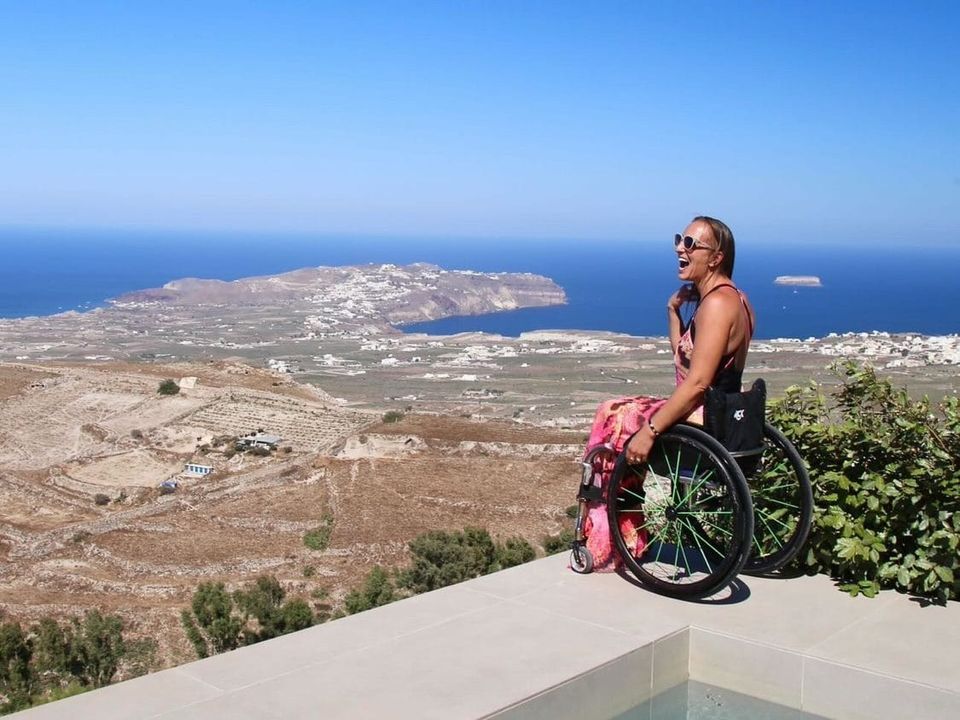
"For a destination so often seen as impossible for disabled travelers, that matters. Because sometimes the biggest shift is not being told everything will be perfect. It is being shown that more is possible than you thought. And in Santorini, I felt that from the top of the island."
Santorini is one of those places people dream about long before they arrive.
The blue domes. The whitewashed villages. The sunsets. The cliffside restaurants. The kind of views that make everyone suddenly become very quiet and reflective, even if they only came for the wine.
But when you travel with access or mobility considerations, Santorini comes with a second layer of questions.
- Where will actually work?
- Will there be steps?
- Will the transfer be okay?
- Will the hotel really be accessible, or just accessible in a very optimistic brochure sort of way?
- Will I spend the trip enjoying myself, or quietly solving problems that nobody else had to think about?
And if you’re travelling solo, those questions can feel even louder.
I know Santorini well. I got married there, I have spent overt a month on the island for work around accessible luxury travel and have experienced the island from quite a few beautiful angles: beachside, boat trips, horse-back, and those ridiculous caldera sunsets that somehow never get boring.
But this trip was different.
This time, I was going alone.
No husband beside me. No family in the background. No one to quietly carry a bag, check a route, ask the awkward access question first, or help me laugh when something went slightly sideways.
Just me, my wheelchair and an island that many people assume is not made for travellers like me.
Which, naturally, made me even more determined to find out whether it would work.
Where I would usually stay in Santorini
For many disabled travellers, the more obvious Santorini base would usually be somewhere like Perissa.
It’s where I’ve stayed previously and it makes sense. Perissa has a long beachfront, a flatter rhythm than many parts of the island, larger hotel-style accommodation, restaurants nearby and a more practical day-to-day feel.
You can roll out for dinner, stay close to the sea and avoid needing a transfer for every little thing.
Kamari often comes into that conversation too.
Like Perissa, it offers a beachside setting, a promenade, restaurants, hotels and a more manageable layout than the cliffside villages people usually picture when they think of Santorini.
Both Perissa and Kamari also have accessible beach options, which matters because Santorini’s beauty is not only in Oia, Fira or the caldera.
Sometimes the luxury is being able to get close to the sea without turning it into a full logistical operation before lunch.
So naturally, for a solo wheelchair-accessible trip, you might expect me to stay somewhere like that.
Beachfront. Practical. Easy to explain.
But this trip was the opposite.
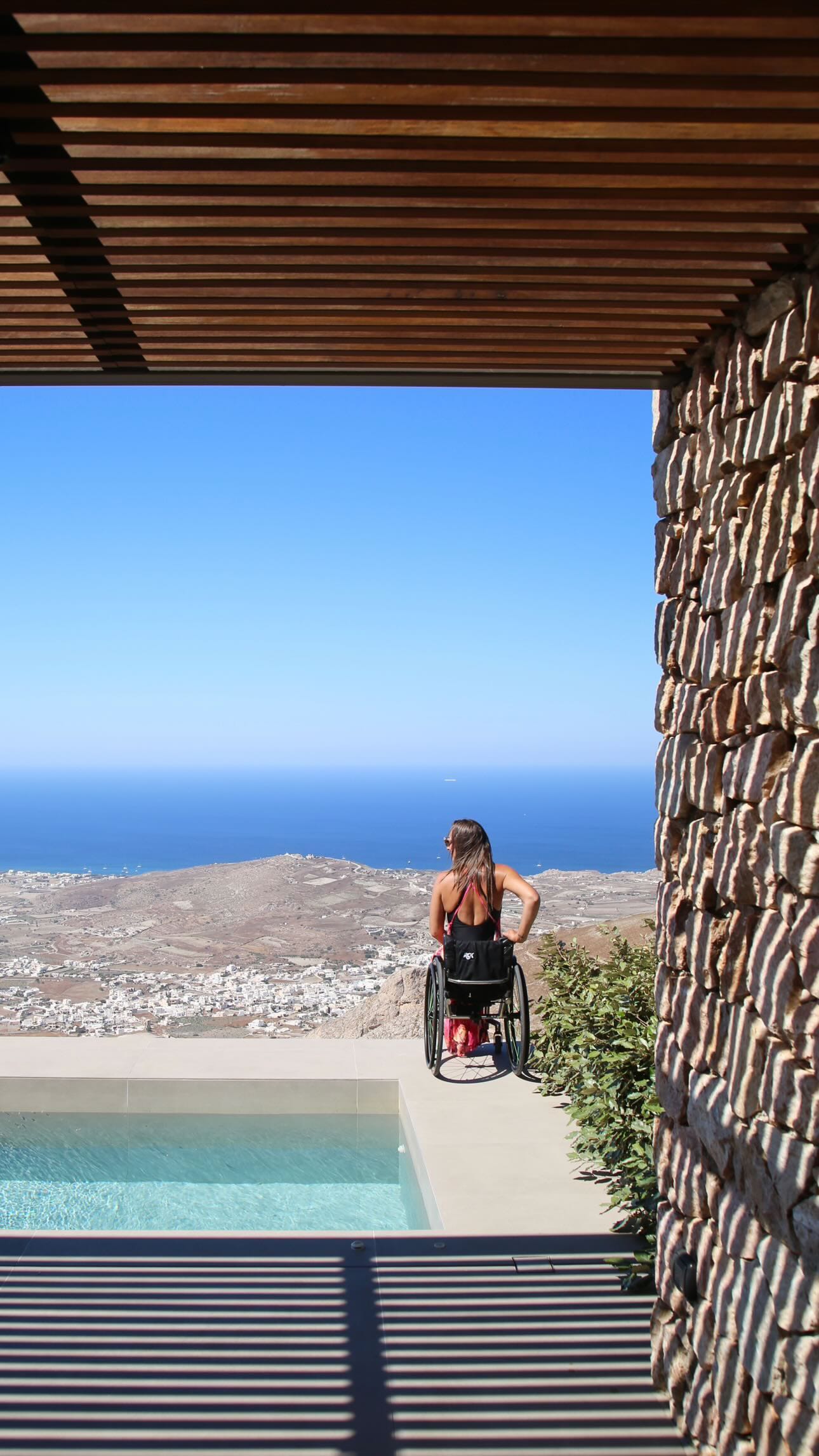
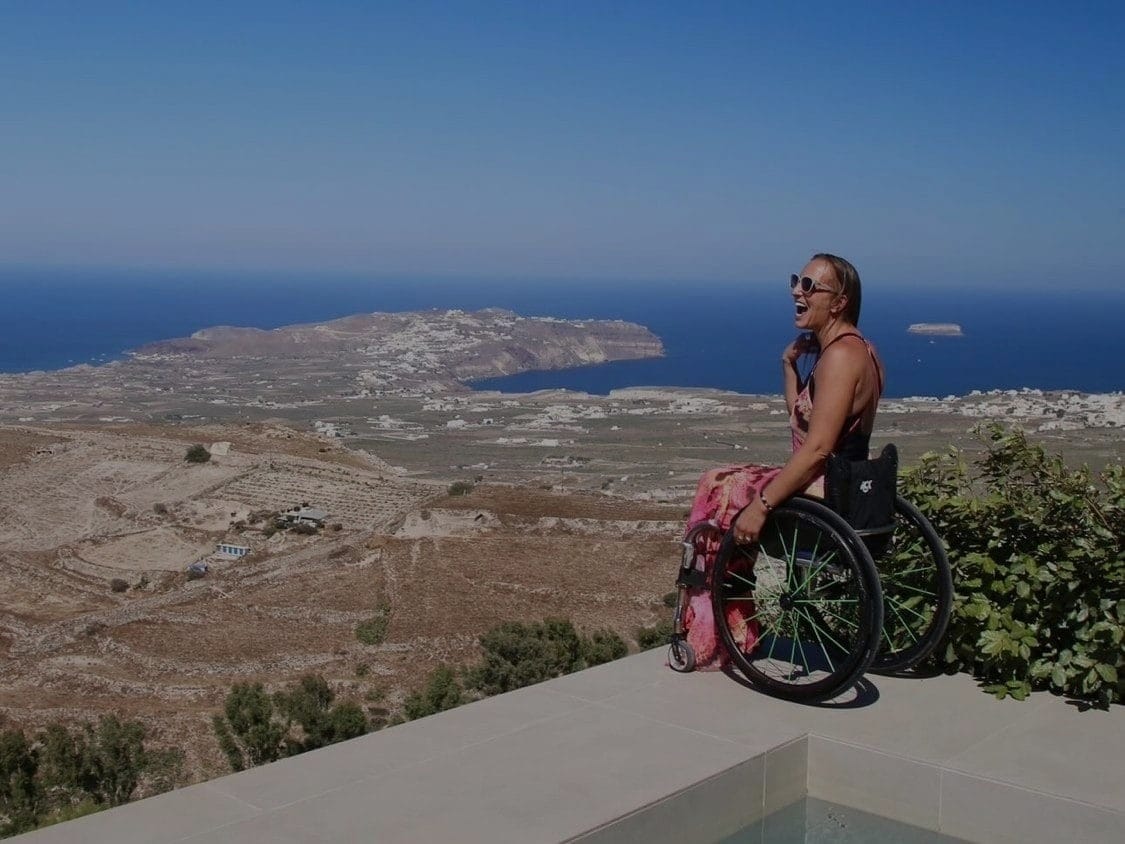
I stayed high above the island, at Santorini Sky, on Mount Profitis Ilias.
Private. Remote. Quiet. On a mountain.
In almost every obvious way, it should have been the less sensible choice.
And yet, it became one of the most confident solo stays I’ve had.
Not because the island suddenly became easy.
Because the right information, the right support and the right accommodation changed what was possible.
Why I chose something different
I didn’t want this stay to be about proving anything.
That matters.
Disabled travelers are very often expected to turn every trip into some sort of brave personal mission. I wasn’t interested in that.
I wanted a beautiful solo stay.
Privacy. Rest. Wine. Food. Views. Wellness. The occasional dramatic “how is this my life?” moment.
Preferably with very little admin.
On paper, a private villa resort high above the island sounds like the kind of place a solo wheelchair user might admire from a distance, then quietly file under “probably not for me”.
Remote locations can be complicated. Private villas can feel isolating.
Mountain roads can make you wonder whether you’ve made a bold lifestyle choice or a terrible one.
But before I arrived, the Santorini Sky team had already started removing the uncertainty.
They asked how I traveled, what kind of transfer I needed, whether I required a wheelchair-accessible van, what pace I wanted from the trip and what practical details would make the stay feel easier.
That changed the whole tone of arrival.
I wasn’t turning up hoping they could make it work.
I was arriving somewhere that had already started considering me.
Access starts before the hotel room
Arriving at an airport knowing there’s a driver waiting is always reassuring.
Arriving as a wheelchair user and knowing the vehicle has already been discussed, chosen and understood before you land is something else entirely.
I didn’t need a full ramp vehicle for this journey, so I chose a Mercedes Vito from Santorini Sky’s fleet. When I landed, my driver Daniel was waiting with chilled water, space for my chair and the kind of calm welcome that makes your shoulders drop before the holiday has even properly started.
That is one of the things people often miss about accessible travel.
Access doesn’t begin at the bathroom door.
It begins at the airport.
It begins when someone has already thought about the thing you were worried, you’d have to explain.
The drive from Santorini Airport towards Pyrgos and up Mount Profitis Ilias was beautiful in the way Santorini drives tend to be. You turn a corner and suddenly the Aegean appears, as if it has been waiting for the correct cinematic moment.
But this felt quieter than the Santorini most people know.
Away from the cruise crowds.
Away from the tightly packed viewpoints.
Away from the places where you sometimes feel like you’re seeing the island through someone else’s itinerary.
When we arrived, Sebastian from the Santorini Sky team was waiting.
I was going to say he met me in the car park, but honestly, that feels slightly unfair. It was less “car park” and more “a place where cars happen to stop before you realise the view is about to take over your personality”.
Check-in didn’t feel like admin.
There was no repeated explanation of things I had already shared. No awkward moment of trying to work out access after arrival. No feeling that I had turned up as a problem to be solved.
Instead, the team already had the important information, which meant we could focus on the stay itself.
That is such a simple thing.
It also changes everything.
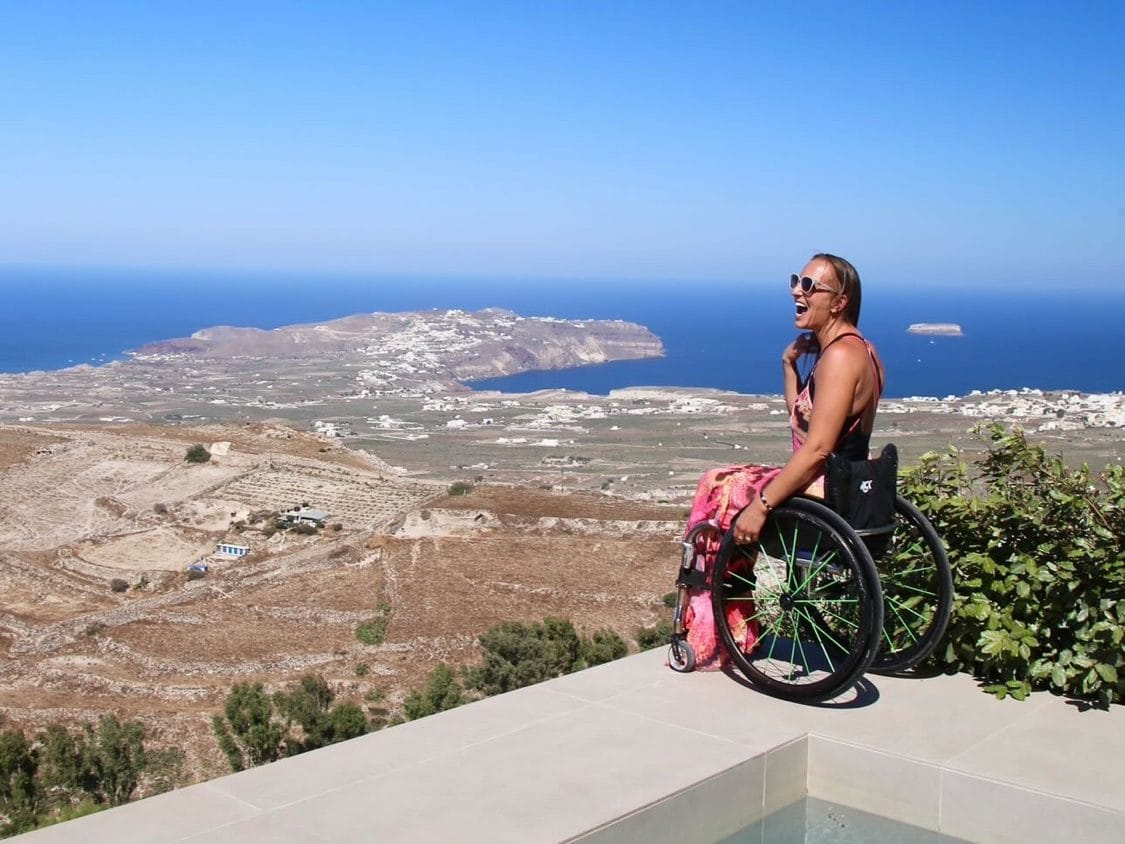
The villa that made staying in feel like the point
My accessible villa was the Junior Residence.
It had step-free access, wide doorways, space to move, a kitchenette and an accessible bathroom with a roll-in shower, shower seat and grab rails.
But the thing I noticed most was that the access didn’t feel separate from the design.
There are accessible rooms where everything functional looks like it was added at the end, with the enthusiasm of someone reluctantly bringing an extra chair to dinner.
This didn’t feel like that.
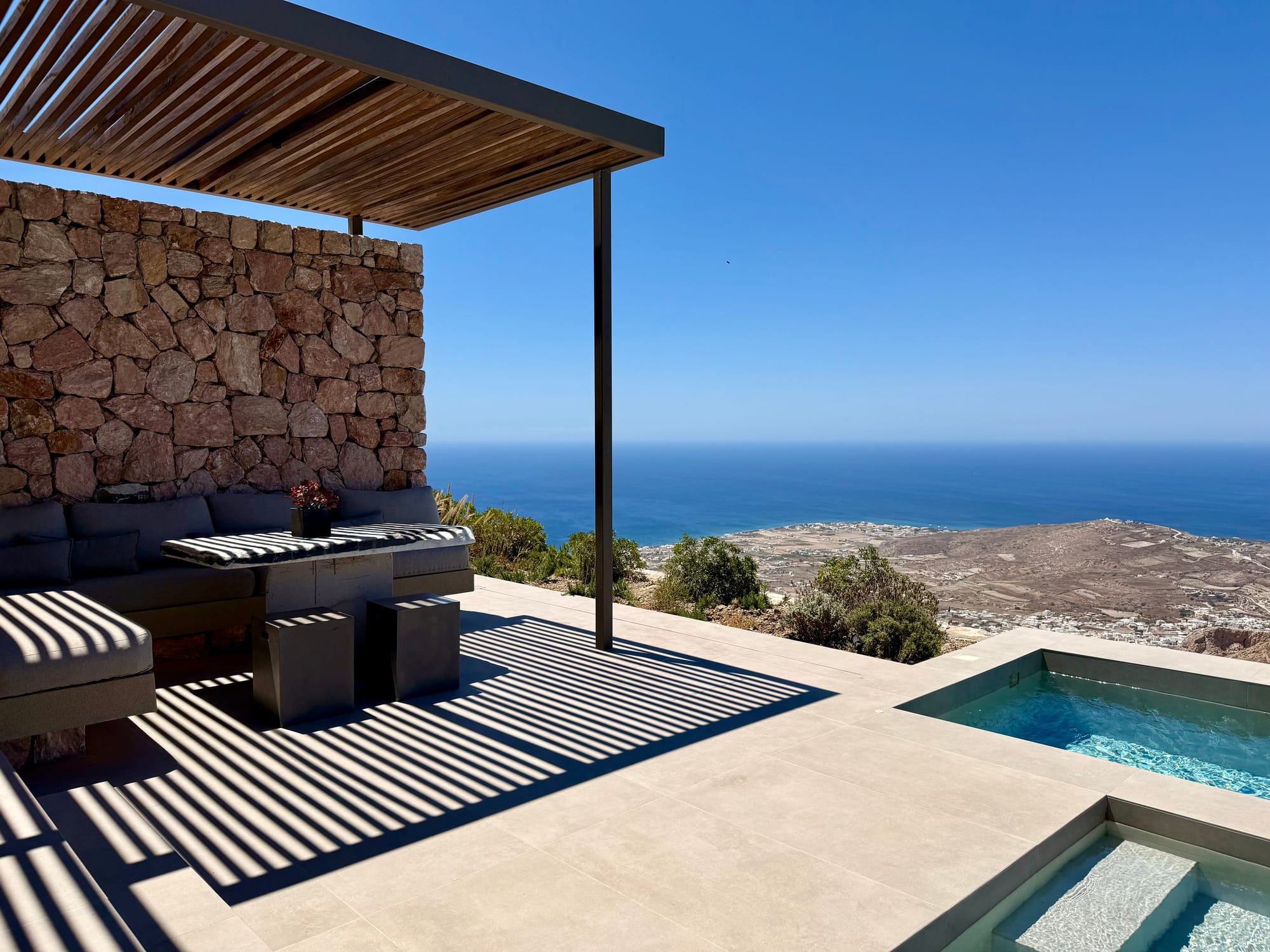
The villa was calm, spacious and beautifully finished. Greek marble, warm textures, soft lighting, a large bed, and enough room to move without constantly measuring the space with my eyes.
Then there was the terrace.
And the terrace was the moment.
Outdoor dining. Sun loungers. A floor-level hot tub with a grab rail. Space to sit at the table in my wheelchair. Space to roll alongside the loungers. Space to simply exist outside without feeling like I had been squeezed into the one accessible corner of someone else’s dream.
Beyond it, Santorini stretched out below.
Blue sea. White buildings. Mountain terrain. Sky for days.
The kind of view that doesn’t just impress you.
It slows you down.
Next door was the larger Residence, which gave the stay another layer. Its main indoor and outdoor spaces worked well for me, and because it sits directly beside the Junior Residence, it could be used alongside it rather than instead of it.
That meant dinner in one space, sleep and bathroom access in another, wellness treatments on the terrace, and the feeling of having a private corner of Santorini rather than just a room.
For couples, families or friends travelling together, that set-up could be particularly interesting. It gives people shared luxury space while keeping the dedicated accessible bathroom close by in the Junior Residence.
For me, travelling solo, it just made me feel wonderfully spoilt.
Which, frankly, I coped with very bravely.
Breakfast without the morning logistics
Santorini Sky has a Sky Lounge for breakfast, brunch and refreshments, but the lounge is accessed by steps. The important thing is that I knew this before I arrived.
So breakfast didn’t become an awkward surprise or a daily negotiation.
It came to me.
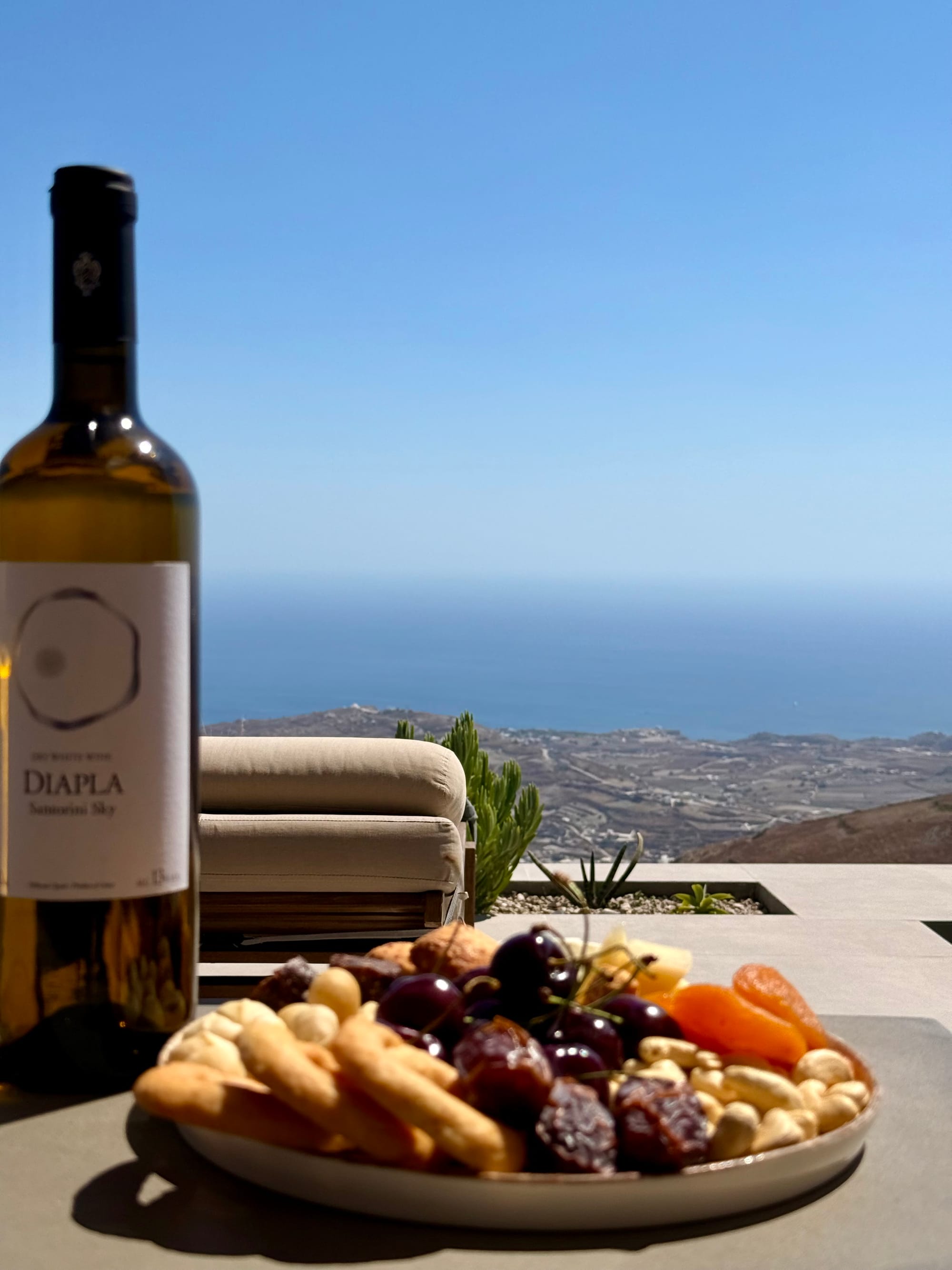
Each evening, I received the breakfast menu for the next morning, with options including local pastries, fruit, eggs, traditional dishes and fresh juices. In the morning, the cold items arrived in a basket, like a little picnic on top of the world.
That may sound like a small adjustment, but it changed the whole pace of the day.
I didn’t have to get ready and move somewhere before I’d even had coffee.
I didn’t have to start the morning with logistics.
I could stay exactly where I was, on my terrace, looking out across Santorini and feeling quietly smug about the view.
This is where accessible travel becomes more than whether every single space is step-free.
Sometimes it is about whether the experience still gives you the same ease, pleasure and choice.
Getting out as a solo traveller
One of my biggest questions before the trip was whether staying somewhere remote would make me feel isolated.
As a solo disabled traveller, location matters. Not just because of distance, but because of confidence.
At Santorini Sky, the team helped shape an itinerary around the kind of trip I wanted. Not a packed schedule. Not a frantic attempt to see everything. Just a thoughtful mix of food, wine, wellness and time to enjoy the villa.
The key thing was that I wasn’t left holding all the uncertainty by myself.
That doesn’t mean every place in Santorini suddenly became accessible.
It means I had support, information and people willing to check details properly.
That is very different.
And very valuable.
The restaurant lesson in Pyrgos
One evening, I went for dinner at Kantouni in Pyrgos main square.
Pyrgos is a traditional hilltop village with winding stone streets, so it doesn’t immediately scream “ideal dinner location for a wheelchair user”.
But you know me.
I like a challenge.
Sebastian had contacted the restaurant ahead of time and been told it was wheelchair accessible. My driver parked right outside, and, at first glance, it looked perfect. There was ramped access to the outdoor dining area, tables beneath the trees and a beautiful, relaxed atmosphere.
Dinner was lovely. Local dishes, warm service and a tiramisu shaped like a coffee bean, covered in chocolate and gold dust.
Was that gold-dust dessert completely necessary?
Absolutely not.
Did I enjoy every second of it?
Obviously.
The learning came when I asked about the bathroom and found out it was inside, up a small flight of steps. When the restaurant said it was accessible, they had meant the dining area was accessible.
Not the whole guest journey.
And this is such a common issue.
Nobody was unkind. Nobody was careless. It was simply a communication gap.
For disabled travellers, “accessible” needs to mean more than “you can get through the door”. It means the entrance, the table, the toilets, the route, the gradients, the cobbles, the parking, the whole thing.
It was also a learning point for me. I would normally ask those questions directly, but because the team had kindly arranged the booking, I had not passed on my full list.
Once I explained what had happened, Santorini Sky went back and checked the rest of my plans in more detail.
That response mattered.
Accessible travel is not about pretending nothing ever goes wrong.
It is about what happens next.
The lunch I could repeat every day
Lunch at Lava Tavern in Perivolos was the kind of afternoon I could happily repeat.
I’d heard about its home-cooked food by the beach, and it was exactly that.
Waves just feet away.
Volcanic sand.
No formal menu, just what had been caught, cooked and brought in that day.
I had stuffed vegetables, Greek salad and one of those lunches that starts as “just an hour” and becomes two, then quietly extends again because ordering an espresso feels like a very reasonable excuse not to leave.
On a practical note, the restaurant and terrace were accessible, and there were no steps to navigate to the toilets. The toilets were very small, which would mean leaving a wheelchair at the door.
That was okay because I knew before I arrived and could make that choice.
That is the important part.
Access information does not always have to make the decision for someone.
Sometimes it simply gives us the dignity of making an informed one.
Wine, cobbles and someone paying attention
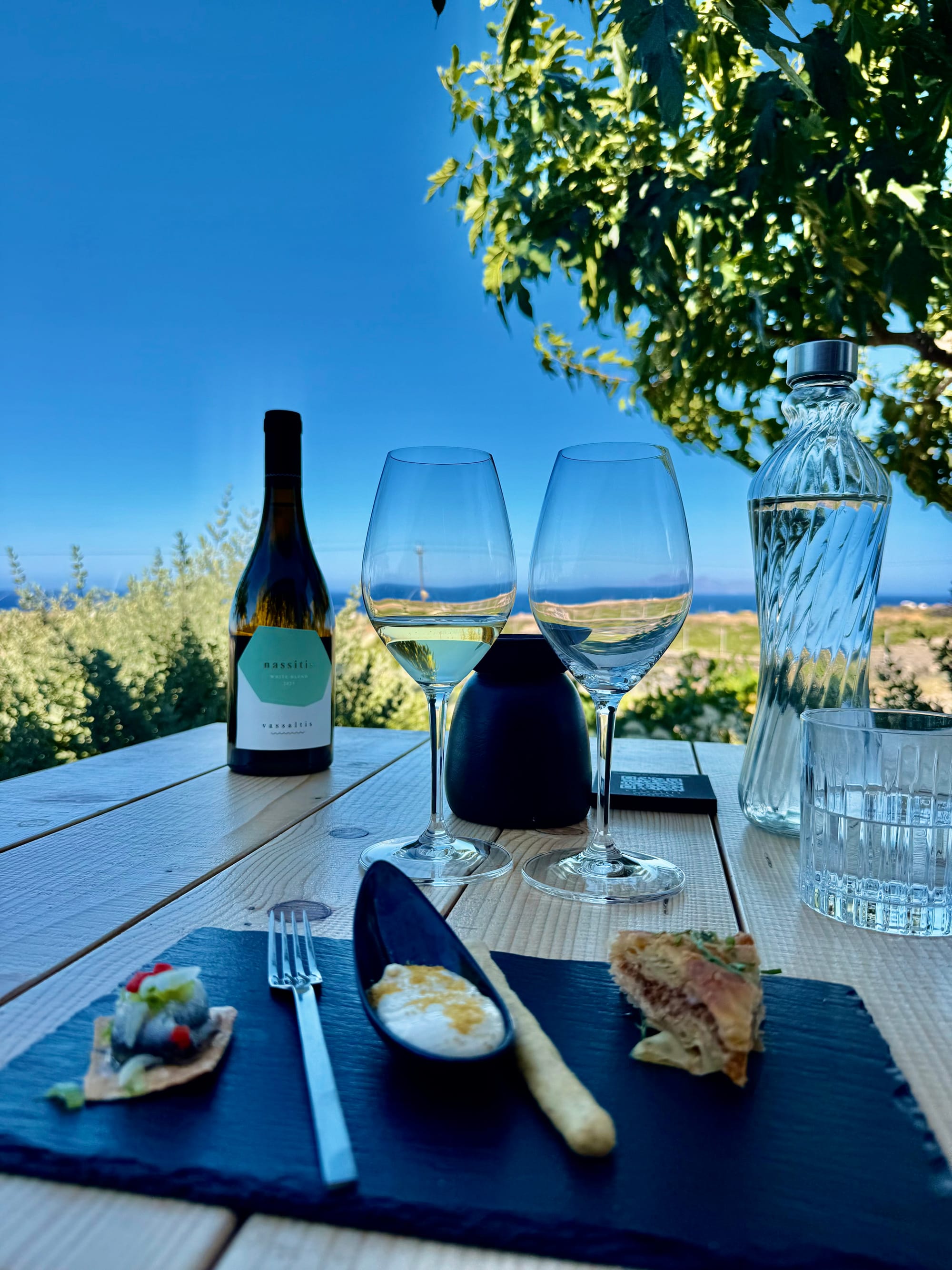
The next day, I visited Vassaltis Vineyards.
The grounds were beautiful, with rows of vines, fruit trees and botanicals set against the Aegean Sea in the distance. It had that modern luxury farmhouse feeling I love calm, spacious, warm and elegant without trying too hard.
I chose a garden terrace table under the trees, because why look at a view when you can immerse yourself inside it.
The tasting included white, red and dessert wines, paired with small plates. Margaret, my sommelier, was knowledgeable, easy to follow and generous with the kind of detail that makes wine feel interesting rather than intimidating.
I like my wine with context, not homework.
From an access perspective, the main winery space worked well. There was level access inside, spacious seating and accessible toilet facilities.
There were cobbles on arrival, which could have been a barrier, although thankfully they were on their best behavior that day and I managed to get across them upright.
Which, as you may know by now, is always the dream.
What I appreciated most came later.
Margaret had noticed the cobbles without me needing to make a thing of it. At the end of the tasting, she showed me a smoother alternative route out and went down herself to make sure my driver knew where to collect me.
No fuss.
No grand announcement.
Just someone paying attention and quietly making the experience better.
That is access in real life.
When plans changed
Not everything went exactly as planned.
I had hoped to visit Alchemia, but the team later found out the ramp was not available. Instead of turning that into a disappointment, Santorini Sky adjusted.
Dinner came to me at the Residence: stuffed vine leaves, fresh cheese pie and local dishes as the sun went down.
It wasn’t the original plan.
It was still beautiful.
And sometimes that is the point.
Accessible travel does not always mean nothing changes. It means there is enough thought, flexibility and care around the guest that a changed plan does not become a ruined experience.
The moment I will remember most
My most emotional moment of the trip was not a restaurant, or a transfer, or even the hot tub with the absurdly beautiful view.
Although, to be clear, I remain deeply supportive of hot tubs with absurdly beautiful views.
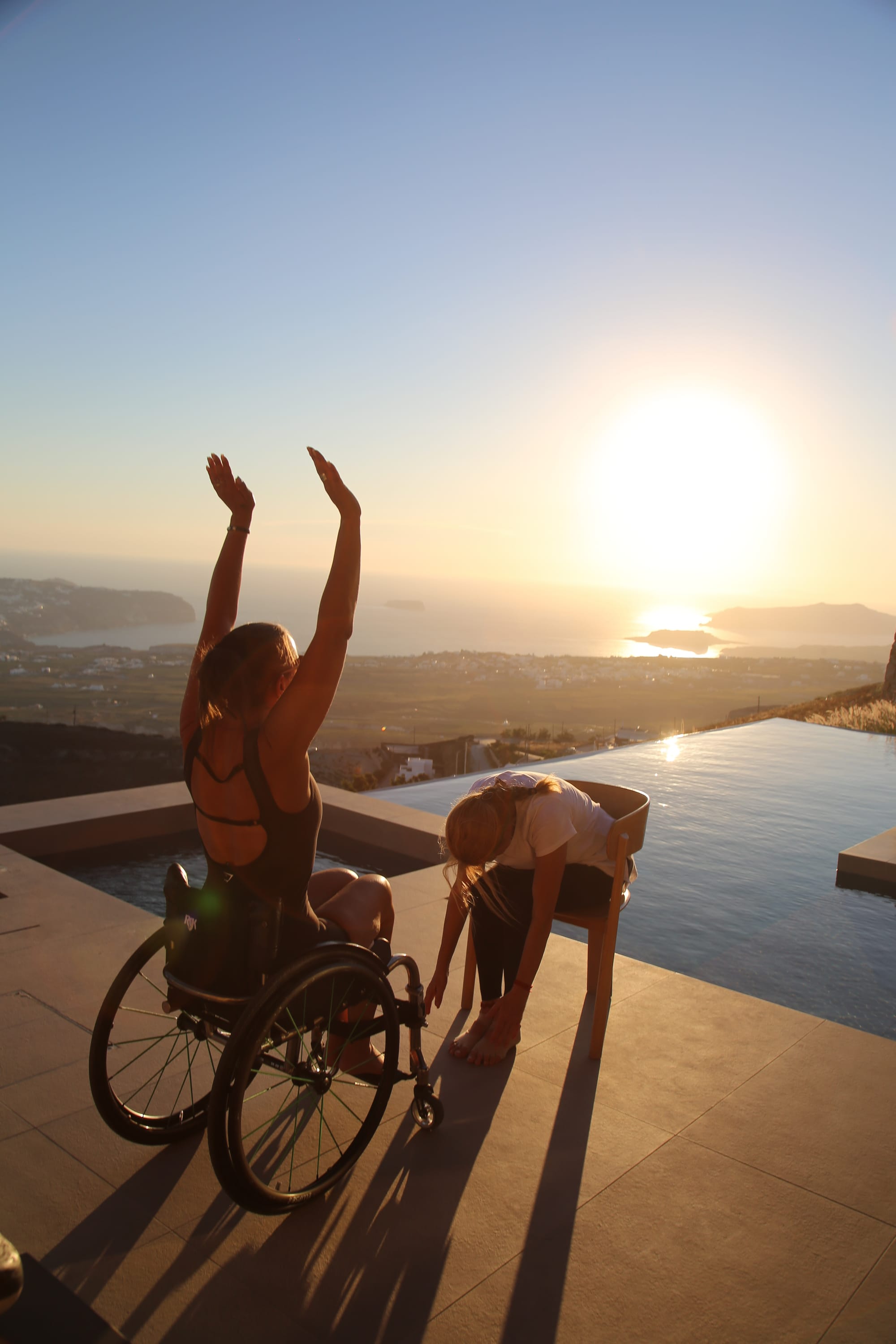
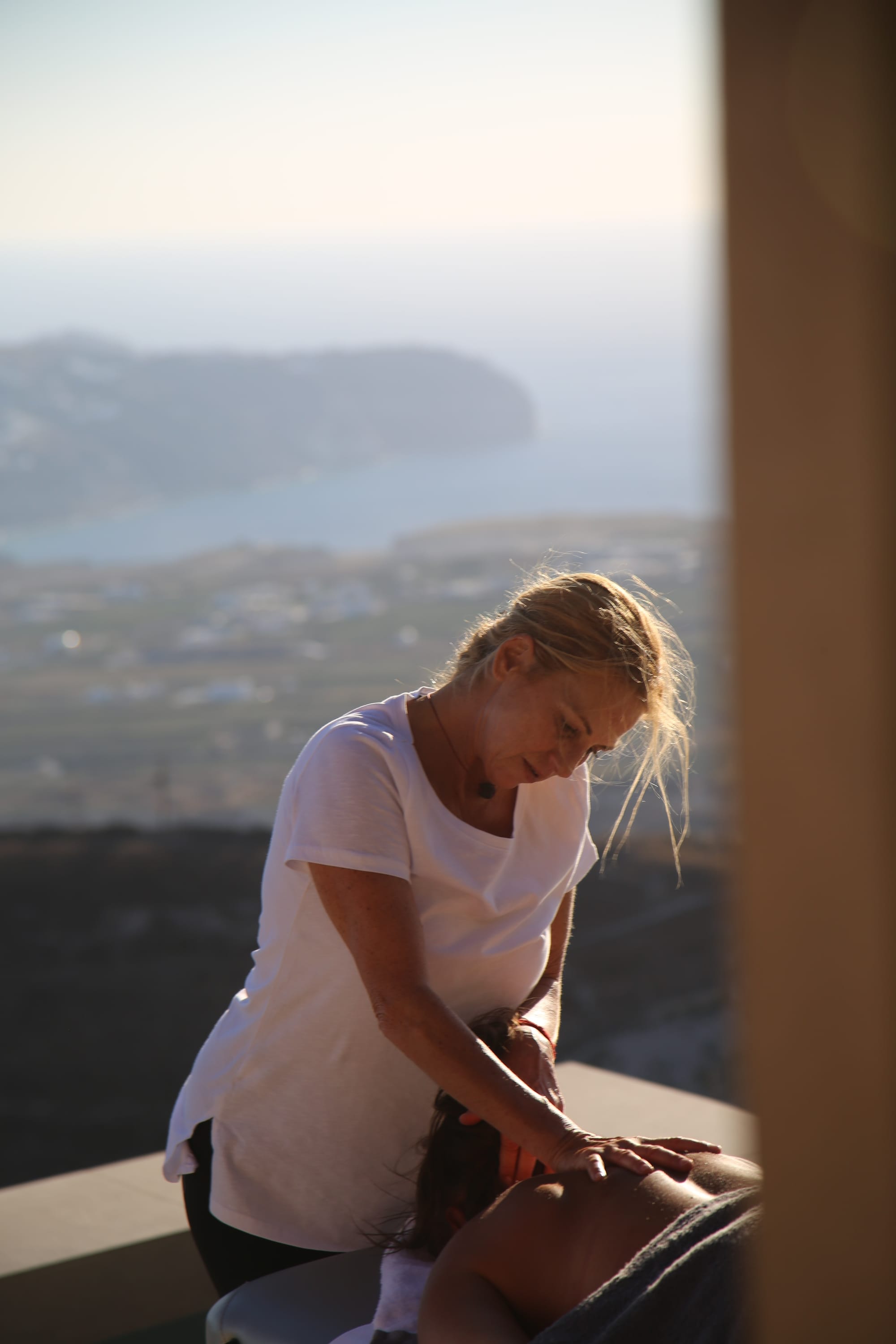
It was the evening Santorini Sky arranged private adapted yoga and massage with Marina from Santorini Yoga and Massage.
Wellness is something disabled travellers are often quietly excluded from. We might get the room that works, but not always the spa, the treatment, the rooftop pool, the beach set-up or the slow, restorative parts of travel.
At Santorini Sky, wellness came to me.
Marina adapted the session with such calm confidence that it never felt awkward or over-explained. The sun was softening over the island. The water was still. The Aegean was in front of us.
At the end, during sun salutations, I felt unexpectedly emotional.
Not because I had “overcome” anything.
I have very little patience for that narrative.
It moved me because I realised this experience had not been forced into existence by me accepting a compromised version of it.
It had been designed to work.
And it could work again.
For travellers with access or mobility considerations. For a couple celebrating something meaningful. For a solo guest who wants privacy, beauty and quiet. For someone who has looked at Santorini and quietly wondered whether this version of the island could ever include them.
Santorini Sky had not made an exception for me.
It had created a new possibility.
It also changes everything.
What I would tell another disabled traveller considering Santorini
I would never describe Santorini as universally accessible.
It is not.
There are steps, cobbles, gradients, narrow streets, historic villages and plenty of places where access can improve.
But I also wouldn’t write it off.
The difference is information.
Ask specific questions. Not just “is it accessible?” but:
- Can I enter step-free?
- Can I access the toilet or bathroom?
- Can the vehicle stop close to the entrance?
- Are there cobbles, slopes or tight turns?
- Is the outdoor seating accessible, or only the indoor space?
- Will the team check again if something changes?
Those questions aren’t fussy. They are the difference between hoping and knowing.
For solo travel, I would also think carefully about your base. Perissa or Kamari may make sense if you want a flatter beachside stay, accessible beach options and restaurants nearby. They are the places I would naturally look at first for practical ease.
But this trip reminded me that accessibility is not only about choosing the most obvious location.
It is about the guest journey around it.
A remote villa can work beautifully if the transfer, communication, information and support are strong enough. A beachfront stay can still fall short if nobody has thought beyond the entrance.
That is why accessible travel has to be more specific than “yes” or “no”.
It has to ask: what kind of trip is this, who is travelling, what support exists, and what does the guest want to feel when they get there?
I needed somewhere calm, private and beautiful.
I also needed a team who understood that a remote location only works if the support around it is reliable.
That combination made the trip possible.
Not possible in a “well, I survived it” way.
Possible in a “I actually enjoyed this properly” way.
And that is a much better standard.
Final thoughts
Traveling solo to Santorini as a wheelchair user taught me something I already knew but needed to feel again.
Accessible travel is not about removing all uncertainty.
No destination can promise that.
It is about replacing guesswork with information, panic with planning, and compromise with choice.
This trip gave me the Santorini people imagine when they close their eyes.
The views.
The wine.
The food.
The sunsets.
The slow mornings.
The moments where you look around and think, slightly dramatically but entirely sincerely, “how is this my life?”
But it also gave me something more practical.
Confidence.
Not because the island was suddenly easy.
Because the right people had asked the right questions, shared the right information and cared enough to adjust when reality needed a different plan.
For a destination so often seen as impossible for disabled travelers, that matters.
Because sometimes the biggest shift is not being told everything will be perfect.
It is being shown that more is possible than you thought.
And in Santorini, I felt that from the top of the island.
About Luiz Faye
Luiz Faye is the founder of The Inclusive Edit, a luxury travel and lifestyle platform exploring how high-quality experiences work in practice for people who move through the world differently. As a wheelchair user, writer and experienced media professional, Luiz brings warmth, lived experience and an editorial eye to accessible travel. She loves beautiful hotels, long lunches, sea views and celebrating the people and places making the world feel more possible for more travellers.
Follow Luiz for more thoughts and experiences on accessible travel:
- Website: The Inclusive Edit
- Instagram: Luiz Faye | The Inclusive Edit
- LinkedIn: Luiz Faye
Ready to plan your accessible adventure?
Find hotels, things to do, and more with trusted accessibility info
Start planning

Comments ()